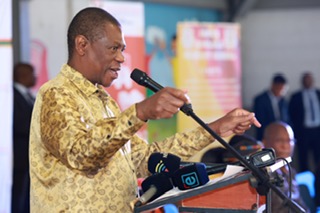
Kariega – The formation of the Government of National Unity demonstrates a powerful response to the call for collaboration and partnership, Deputy President Shipokosa Paulus Mashatile said on Human Rights Day.
In a wide-ranging speech at the Derrick Ferreira Stadium in Kariega, Eastern Cape on Friday, (21 March 2025), Deputy President Mashatile referred to the last elections saying: “The message from all our people was loud and clear: Work Together”.
The deputy president said it was an honour to be in the Eastern Cape, the “Home of Legends”, especially in Kariega, a community he said “exemplifies both the tenacity and the challenges” faced by many South Africans.
“Today is Human Rights Day, commemorating the 1960 Sharpeville Massacre, in which apartheid police killed 69 peaceful protesters protesting apartheid-era laws, as well as honouring the struggle for freedom and democracy,” Deputy President Mashatile said.

“Sixty-five years have passed since that day when the world bore witness to the brutality of the Apartheid government in confronting those who sought equal economic, political, and social rights.
“Years later, in what was formerly known as Uitenhage, and now Kariega, the Langa Massacre occurred on 21 March 1985, resulting in the indiscriminate killing of 20 people who were fighting for justice against the oppressive regime.”
Deputy President Mashatile said the Sharpeville and the Langa Massacres both starkly illustrate the grave human rights violations by the then apartheid government.
“These tragic events exemplify the immense human cost of oppression and compel us to renew our commitment to building a society where such injustices are never repeated,” he said.
Following international outrage, The United Nations General Assembly declared 21 March as International Day for the Elimination of Racial Discrimination, highlighting global solidarity in the fight against apartheid and a milestone in the global fight against racism.
“The 60th anniversary of International Day for the Elimination of Racial Discrimination calls for reflection on progress against racial discrimination and equal treatment for all individuals,” the deputy president said.
He said this year’s commemoration theme, “Deepening a Culture of Social Justice and Human Rights,” was not simply a slogan.
“It is a commitment to ensure justice and equitable outcomes for marginalised people, requiring renewed commitment from all sectors of society,” Deputy President Mashatile said.
“It calls on us to deepen our efforts in building a culture that respects and upholds human rights.
“This requires us to recognise the inherent value and dignity of every individual, regardless of their background, beliefs, or circumstances.
“It is important for us to actively confront the systemic inequalities that perpetuate injustice.”
He said the fight for rights and freedom transcends national boundaries; it is a global imperative.
“Our commitment to this cause is reflected in the efforts of countless individuals fighting for justice around the world and in the sacrifices made by many on different fronts, including the brave South African Defence Force troops deployed to the Democratic Republic of the Congo, as well as closer home here in the Eastern Cape, the highest prize paid by a human rights activist and whistleblower, Ms. Pamela Mabini, who was gunned down at her home in Gqeberha a week ago,” the deputy president lamented.
“May their souls continue to rest in eternal peace!
“In addition, Compatriots, our involvement in the case at the International Court of Justice highlights South Africa’s commitment to international justice.
“Certainly, the pursuit of a just and equitable world requires continuous dedication, not only within South Africa’s boundaries, but also globally.
“We all have a responsibility to create a world in which justice and human rights are upheld for everyone.”
He said the Freedom Charter, adopted 70 years ago, remains a relevant document that should guide South Africa’s path towards a just society.
The Freedom Charter’s vision of a society where “all shall be equal before the law” and “the doors of learning and culture shall be opened” resonates deeply with the ongoing struggle to address systemic inequalities and to ensure equal opportunities for all.
It calls for land redistribution, quality healthcare, and the elimination of discrimination.
Flowing from this foundational document is the Constitution of the Republic of South Africa, with its adoption in 1996 marking a pivotal moment in our history.
Beyond its provisions, it signifies a pivotal transition towards justice and equality, a change manifested in the creation of state institutions intended to safeguard our democratic and constitutional principles, such as the Constitutional Court and Chapter 9 institutions.
In particular, the Constitutional Court, established through the first democratic Constitution and the 1996 Certification case, upholds constitutional supremacy and rule of law, ensuring equal rights for all citizens and just application of laws.
Its landmark cases reflect a commitment to social justice, shaping policy-making and legal landscapes while upholding citizens’ rights.
Another critical institution within this framework is the South African Human Rights Commission, which alongside the Constitutional Court, celebrates 30 years since its establishment.
These constitutional independent bodies are vital instruments for protecting and promoting human rights.
“They are essential components of our democratic order that reflects our dedication to the ideals enshrined in our Constitution,” said Deputy President Mashatile.
“Our democratic government has also taken responsibility to respect, protect, promote and fulfil the rights in the Bill of Rights.
“We have established an environment that strives to uphold human rights and fundamental freedoms for all.
“Through the adoption of our Constitution, constitutional obligations have been created for the state, distinguishing us from the divisive government of the Apartheid era.”
It is also 30 years since the establishment of the Truth and Reconciliation Commission, which served as a crucial step to address past injustices, provide reparations to victims, and promote reconciliation.
While progress has been made in certain areas, significant work remains to fully implement the TRC’s recommendations, particularly in addressing systemic inequalities and ensuring that all victims receive appropriate redress.
Restorative justice is a continuous process requiring commitment from all societal sectors.
The TRC has been hailed for its innovative approach to holding those responsible for human rights violations accountable and fostering reconciliation among all South Africans, a model that has been adopted by many countries post-conflict.
The African Union has adopted the theme “Justice for Africans and People of African Descent through Reparations” for 2025, urging South Africa to share its experiences in adopting an incremental approach to reconcile past apartheid and colonial history.
“The pursuit of a just and equitable society is a complex endeavour,” the deputy president said.
“While South Africa has experienced notable economic growth through expanding economic participation, the harsh reality of a 31.9% unemployment rate starkly reveals our ongoing struggle against poverty and inequality.
“This is not merely an economic issue; it represents a fundamental matter of human rights and fairness, demanding concerted and sustained effort from all of us.
“The lack of economic and employment opportunities has a direct correlation to poverty, and it exacerbates inequality.”
He said the government was working to create more opportunities for all citizens through various policy and legislative frameworks.
Programmes such as the Presidential Youth Employment Initiative (PYEI) are providing work experience to over 1.5 million young people, 70% of whom are women.
Other initiatives like the National Skills Fund Disabilities Programme and the Social Employment Fund also address youth unemployment.
Deputy President Mashatile said the government remains committed to strengthening the safety net for the most vulnerable in society.
“We will leave no one behind,” he said.
“As we commemorate Human Rights Day this year, we are reminded that the legacy of our struggle is not just one of remembrance but one of action.
“Across the country, young people continue to step forward to shape the future of our democracy, ensuring that the rights enshrined in our constitution are not just theoretical but truly lived.”
One such initiative is the Mandela-Sobukwe Leadership Camp, currently taking place at Nelson Mandela University here in Gqeberah.
This programme, hosted in partnership with the Departments of higher Education & Training, Health, and Nelson Mandela University, brings together student leaders from universities, TVETs, and CET colleges across the Eastern Cape.
This leadership programme is about more than just discussions it is about preparing young leaders to champion civic engagement, ethical leadership, and economic justice in their institutions and communities.
“As we reflect on the theme ‘Deepening a Culture of Social Justice and Human Rights’, we must ensure that we continue to empower young people with the correct tools, platforms, and opportunities to become the leaders of tomorrow – leaders who, like Nelson Mandela and Robert Sobukwe, do not just accept the status quo but actively work to transform it for the better,” the deputy president said.
“I commend the young people in this programme, whom I am told are here in the stadium and all those across the country who continue to fight for dignity, justice, and progress.
“South Africa’s future is in your hands, and today, we celebrate your voices, your leadership, and your unwavering commitment to human rights.”
Building a just society involves ensuring continued access to critical services such as electricity, water, housing and sanitation to improve the quality of life for our citizens.
“Our Government has made substantial progress towards achieving these rights. Between 2011 and 2022, access to water rose to 88.5%, while access to improved sanitation reached 80.7%,” said the deputy president.
“We are also working to increase access to affordable housing through initiatives such as First Home Finance, which is about the provision of serviced sites for qualifying beneficiaries, small-scale affordable rentals, and other strategic interventions that go beyond legislative measures to address the 2.4 million housing backlog.”
Deputy President Mashatile said it was important to remember that apartheid had a huge economic impact due to its systemic dominance, marginalisation, and dispossession.

The Natives Land Act of 1913, a cornerstone of colonialism and apartheid, restricted land ownership and occupation by Black South Africans, leading to forced removals and the creation of “native reserves,” ultimately paving the way for further racial segregation.
“Our land reform agenda is therefore a crucial step toward healing the historical wounds of the past, as it acknowledges that land dispossession remains one of the most lasting and difficult legacy of that era,” he said.
The Expropriation Act, signed into law by President Cyril Ramaphosa in January this year, signifies a shift towards a more inclusive approach to land ownership, incorporating the principle of ‘public interest’ in land acquisition, and demonstrating a commitment to social justice and redress.
“We would like to reiterate that South Africa, as a sovereign state, would not disregard its policies and activities aimed at rectifying historical injustices due to external pressure,” Deputy President Mashatile said.
“We are confident that we have chosen the correct path to establishing an equitable society, and we will not deviate from it.”
He said the National Development Plan further emphasises the importance of land reform in unlocking the potential of the agricultural sector to drive dynamic economic growth and create employment opportunities that contribute to a more just and prosperous future.
“It also necessitates robust and accessible infrastructure that connects communities and empowers citizens,” the deputy president said.
“Adequate infrastructure facilitates access to essential services and opportunities, protection of human rights, and fostering a more equitable society.
“While we acknowledge the significant infrastructural backlogs that have hindered progress in this area, the R940 billion allocated to infrastructure over three years, along with R102 billion invested in current projects in the Infrastructure Fund portfolio, will be crucial in addressing these shortcomings.”

He said this significant investment focuses on water and sanitation infrastructure, human settlements, renewable energy, recreational, heritage and maritime infrastructure upgrades, road rehabilitation, state-owned building refurbishment, and health facility upgrades.
“Our social justice strategy must focus on equipping citizens with the knowledge and skills necessary to access opportunities and build a better life for all,” the deputy president said.
“Education is paramount in this regard.
“By strengthening our education system and addressing challenges such as scholar transport and malnutrition, we can create pathways for equal opportunities.
“In this regard the full implementation of the Basic Education Laws Amendment Act of 2024 (BELA ACT) will promote early childhood development by optimising and strengthening foundational learning.”
He said ongoing efforts to increase access to education through mobile classrooms and eliminate pit toilets.
The Department of Basic Education’s launch of an application in 2024 to track pit toilet eradication, was critical for fostering a more just society and ensuring a safe schooling environment, particularly for our younger learners.
Additionally, the Department of Basic Education is committed to ensuring quality education for all children, especially those in rural areas.
The Department of Basic Education was also reviewing the Scholar Transport Policy to better accommodate learners with disabilities.
The goal was to make education accessible and tangible for everyone, regardless of their social or economic status.
“We cannot achieve social justice without actively including and uplifting those who have historically been marginalised in our society,” the deputy president said.
“This imperative is pertinent when we consider the dimensions of poverty and inequality, notably the experiences of women in South Africa.
“We must acknowledge progress made and the urgent need to tackle gender-based violence.”
The Human Sciences Research Council’s first national study revealed the widespread nature of gender-based violence, impacting women’s access to justice and highlighting the need for collective action.
He said addressing this crisis requires strengthening institutional capacity, especially within law enforcement agencies, and a comprehensive response.
“We acknowledge the recent findings of the Public Protector, highlighting administrative deficiencies in its report on gender-based violence. Our systems must indeed work for our people,” Deputy President Mashatile said.
The National Prosecuting Authority has high conviction rates for femicide, intimate partner femicide, and sexual offences, demonstrating a strong commitment to justice.
The National Council on Gender-Based Violence Act of 2024 further strengthens this commitment.
“However, we must also urgently address critical challenges in the justice system, including tackling DNA backlogs and expanding access to Thuthuzela Care Centres to ensure that survivors receive both support and justice,” he said.
The 2022 Presidential Summit on Gender-Based Violence and Femicide highlighted the importance of economic empowerment in combating this pandemic.
Despite progress in women’s representation in middle and senior management positions between 2019 and 2023, significant work remains to achieve full gender parity.
“This requires sustained efforts to empower women economically and address the root causes of gender-based violence and femicide,” he said.
“To establish a society where all individuals can live with dignity, security, and equality, we must actively challenge systemic inequalities and harmful norms that perpetuate violence against women and other vulnerable groups.
“We have noted that Gender-based violence and HIV/AIDS are interconnected issues, disproportionately affecting vulnerable populations.”
Deputy President Mashatile said the recent withdrawal of PEPFAR funding by the new U.S.A. Administration, which currently funds about 17% of South African health programmes, may exacerbate this situation, threatening access to essential healthcare services.
“This highlights the urgent need to build a resilient and self-reliant healthcare system,” he said.
“To this effect, our government is developing contingency plans to mitigate the impact of reduced funding, protect those affected by HIV/AIDS, and uphold human rights commitments.
“Government remains committed to ending the AIDS epidemic as a public health threat by 2030.”
Deputy President Mashatile said the commitment was backed by a pro-poor budgeting strategy that directly enhances the lives of the most vulnerable, by directing resources towards those in need, thus making human rights a tangible reality.
He said embracing a culture of social justice and human rights requires active participation from every citizen.
“Our democratic government gives previously excluded communities a powerful voice, stressing the critical importance of participating in collectively moulding our country’s future,” the deputy president said.
“Active participation is not just a right, but a responsibility to uphold the ideals enshrined in our constitution.
“The 2024 elections highlighted the challenges we face in promoting active citizenship and fostering a culture of participation and accountability.
“Only 16.2 million out of the 27.2 million registered voters cast their ballots, a concerning figure given the sacrifices of those who fought for our democracy.
“The GNU thus represents a direct response to the people’s desire for unity in tackling our nation’s most pressing challenges.”
He explained that the GNU was committed to implementing three strategic priorities over the next five years.
Firstly, to drive inclusive growth and job creation.
Secondly, to reduce poverty, address the high cost of living, and thirdly, to build a capable, ethical, and developmental state that prioritises human rights.
“The success of the GNU’s ambitious agenda depends on the active participation of each and every citizen,” he said.
“In the same spirit of participation, the President will, later this year, lead the National Dialogue.
“We will ensure that this Dialogue is inclusive and allows everyone to contribute to what we need to do to build a country of our dreams.
“The task before us requires a unified effort, a partnership between government, civil society, business, and each and every citizen.”
Deputy President Mashatile added: “Let us embrace our individual responsibility to shape our nation’s future by exercising our democratic rights and working together to build a South Africa where social justice and human rights are not merely ideals, but a lived reality for all.
“Let us continue to be champions of social justice and human rights.
“On behalf of the President [Cyril Ramaphosa] and the whole of [the] government, I wish you a Happy memorable Human Rights Day.”
President Ramaphosa was in Namibia for the inauguration of that country’s first female President, Netumbo Nandi-Ndaitwah.

*All images courtesy of GCIS