Reviewer: Bhekisisa Mncube
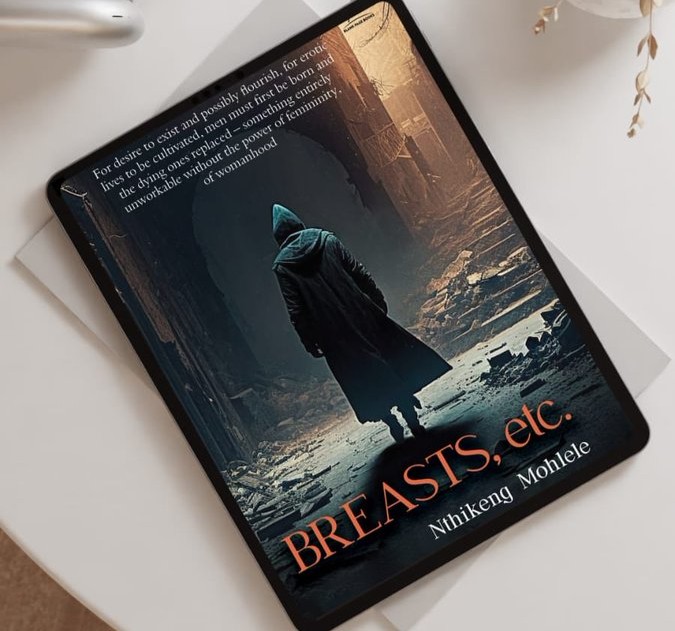
I have just finished reading a book with the curious title “Breasts, etc.” by TK, that enigma of our literary scene – perhaps not as reclusive as his (my) idol, J.M. Coetzee, but still a figure shrouded in intrigue.
At first, the book read like an essay about breasts – women’s breasts, to be precise- though it was marketed as a novel.
Midway through, the tempo quickened, and more characters emerged, fleeting yet integral participants in the narrative.
TK is incapable of writing ordinary British English or crafting a book with a straightforward plot and a neat, satisfying ending.
He isn’t a master of prose in the conventional sense; instead, he is a poet, a lyricist whose carefully chosen words create music for the soul.
His obsession with the apocalypse – a recurring theme in his dreams – imagines a world where femininity itself, breasts included, is obliterated.
He imagines men hugging women’s scriptures, bored, lost without women, and also being the last living creatures on earth who will fall short of food and feed on rodents.
Yet, paradoxically, this obsession with breasts and the apocalypse forms the foundation for a beautiful love story centred on a triangular dynamic, including his “first love”, Winnie.
She is the first woman who introduced him (James) to bare breasts (no sex), which in turn gave him a fulfilling career in nude photography.
Though not declared overtly, this love of Winnie evokes André Brink’s sentiment in Before I Forget, where he muses that sometimes, “love is greater for being unfulfilled,” a mantra I live by.
Our narrator, James, is a man fascinated by the female form, specifically the breasts, which he captures as a nude photographer.
His art seeks to immortalise “a fleeting moment before the ravages of decay and old age” (emphasis mine). Against his ethical instincts, James falls in love with one of his subjects, Esmeralda Abedienne, a woman whose essence transcends mere physicality.
It is a love story that transcends breast worship, old age, death, and decay, not to mention the apocalypse that never occurred.
This is not simply a tale of breast worship; it is a meditation on love, mortality, and art.
It is a story that defies the apocalypse, weaving themes of beauty, meaning of life, ageing, and decay into a narrative of transcendence. Despite the author telling us, “Life is a voyage to the grave.”
In Breast, etc., TK has produced a feminist manifesto- replete with poetry, music, and restrained eroticism as the only appreciation of breasts, that frees the book from being fascinated with the sexual connotation of breasts.
Thus, the book sidetracks criticism by the woke crowd, sex purists, and literacy classification. Perhaps it is dystopian due to the recurrent dreams of the apocalypse.
However, I can’t escape the cruel killing of Winnie’s husband (cause of death alcohol poisoning), whom the narrator never loved, referring to him as an “intellectual toad” and a failed athlete.
Notwithstanding the narrator displaying his “jealous lover” streak by taking literary liberty to kill a character who had, in his mind, outlived the usefulness of his existence, the novel is, indeed, a magnum opus.
*Bhekisisa Mncube is the author of three books: The Love Diary of a Zulu Boy, The Ramaphosa Chronicles, and Kumnandi eMakaya. He has also contributed to five additional works. When he’s not winning awards for his columns — as a regular columnist for Daily Maverick, former contributor to The Witness, and guest writer for News24, LitNet, and City Press—he can be found deep in conversation with his two cats, Smudge and Tigger.