

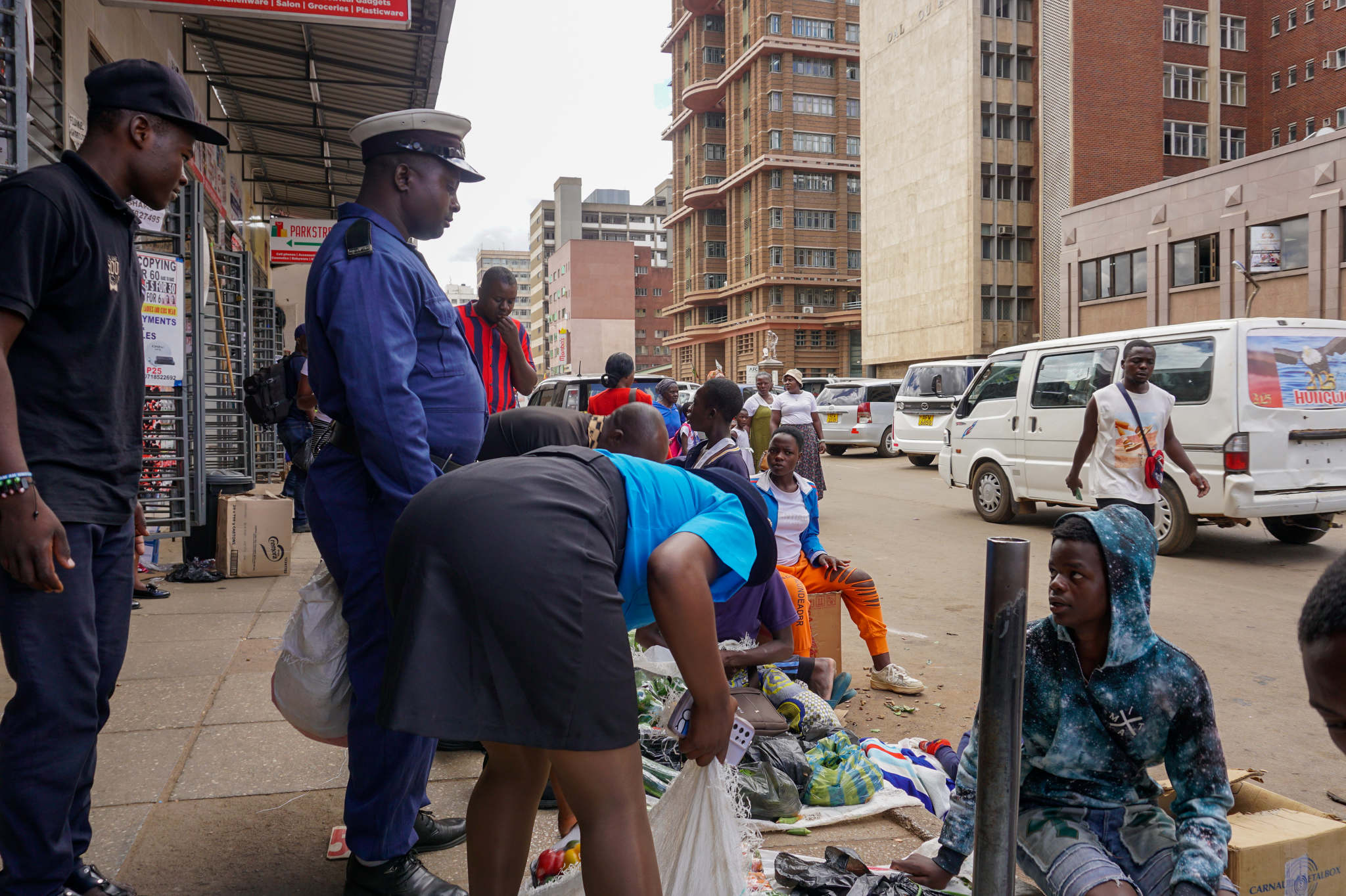
Harare – The vendors rarely see it coming.
The municipal police, some in plain clothes and others in uniform, move through the crowd silent and unnoticed.
When they finally strike, panic erupts.
Vendors scatter, trampling their goods and grabbing what they can.
A few are arrested.
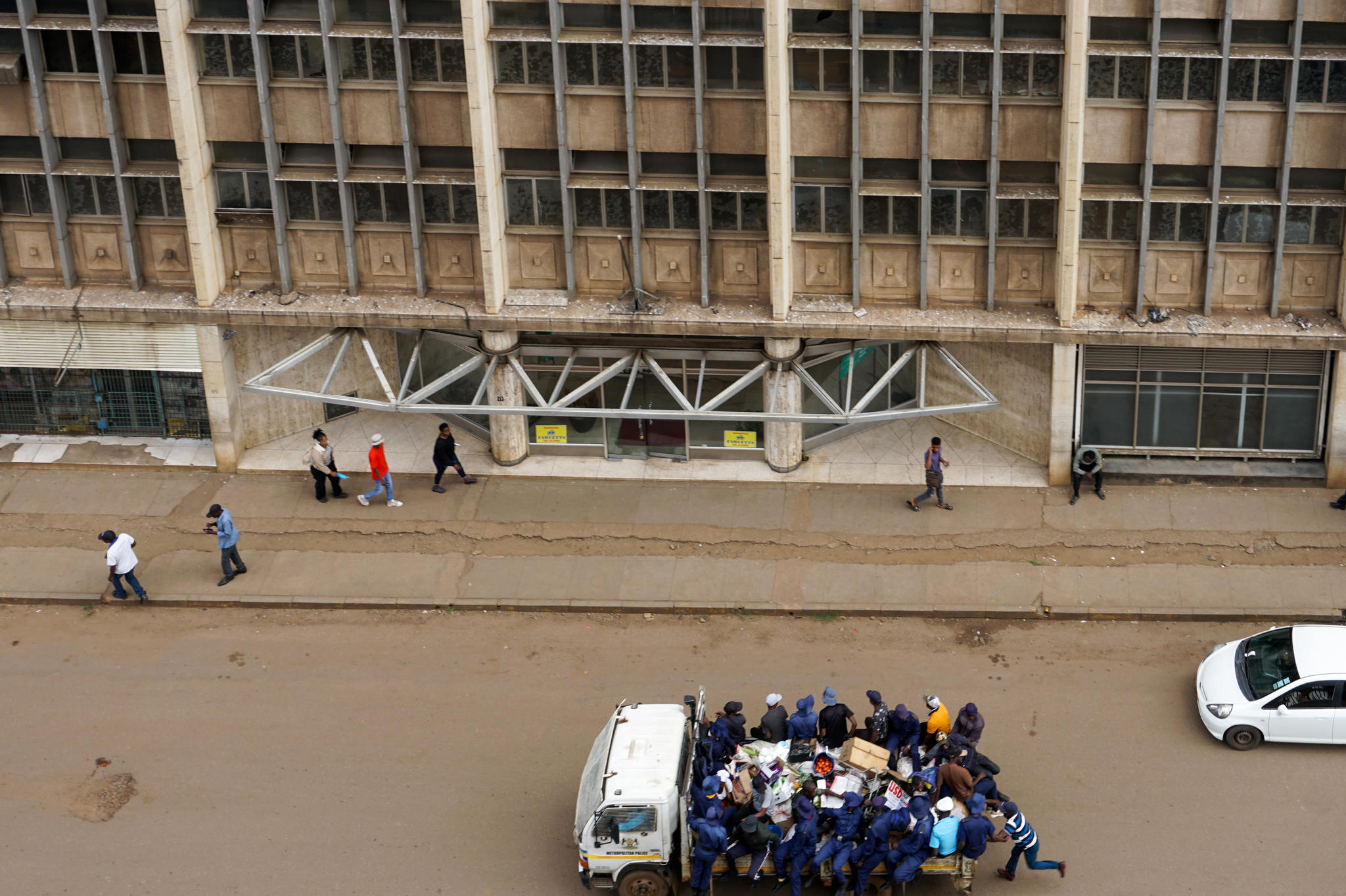
Their wares are seized and tossed into the back of a police truck.
“They have no mercy at all. Once they take your stock, you’ll never get it back,” says Saul Nhema, an informal vendor who has been selling vegetables for three months after losing his job as a construction worker.
On the day of this interview, the municipal police had already raided these informal vendors selling along Park Street in Harare’s central business district twice.
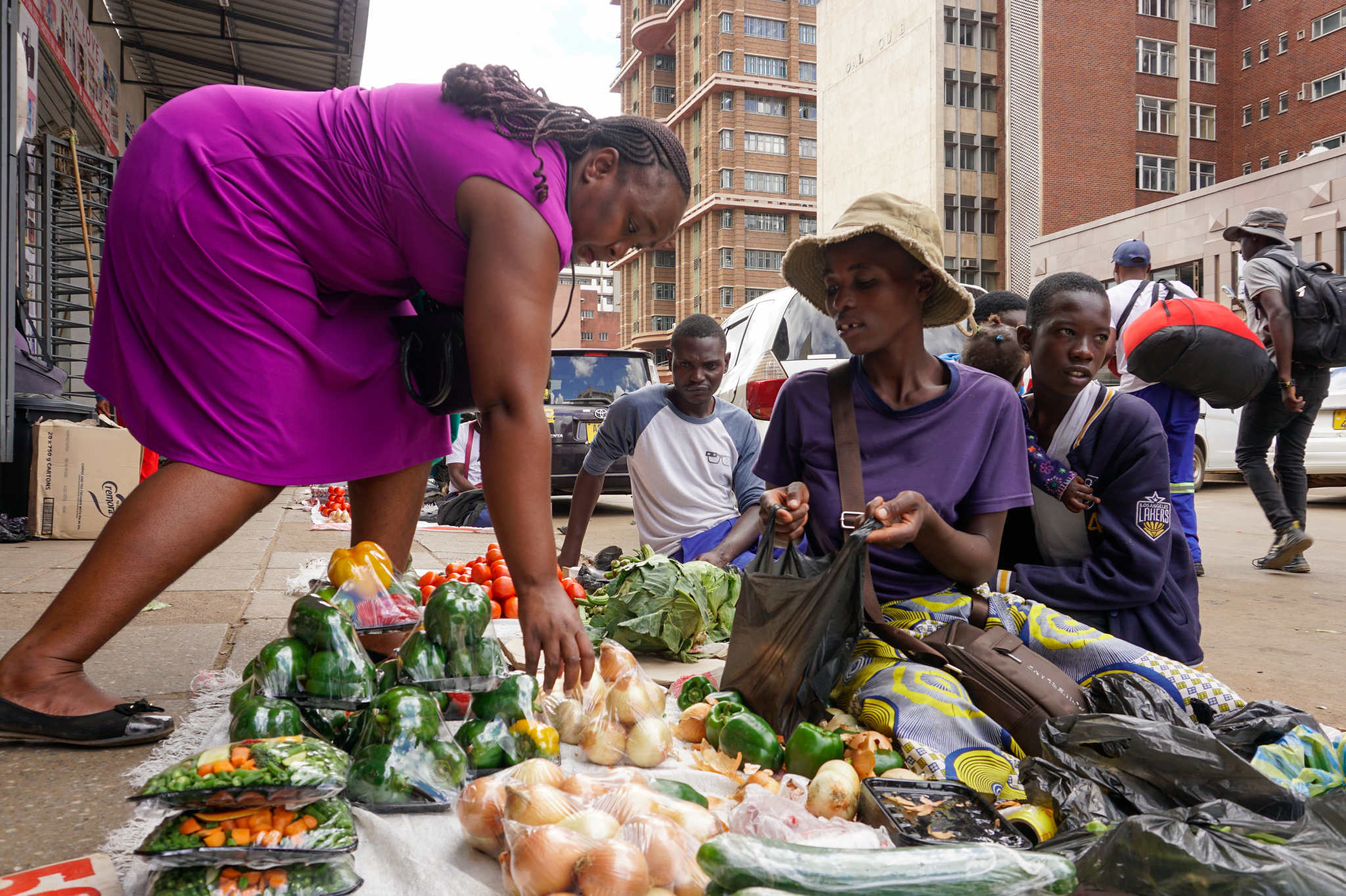
As Global Press Journal reporters interviewed Nhema, they struck again.
He grabbed his stock and fled in the middle of the interview.
The Harare City Council has for years waged such crackdowns on vendors, often destroying goods and deploying heavy police forces.
Local government insists these crackdowns are necessary to enforce city bylaws, citing vending from illegal spots, littering, and health concerns.
Yet the scale and intensity of recent operations, backed by expanding police presence and significant public spending, have raised questions.
Critics argue that the government is wasting scarce resources targeting informal vendors all while it struggles to provide city residents with basic services, such as clean water.
In 2024, the council’s revenue stood at just US$3 million.
But policing costs for these crackdowns exceeded US$24 million, eight times the council’s income.
In 2025, the council escalated its crackdown by creating a specialised police unit to target vendors, further deepening the financial strain with a slight budget increase – and pushing the total to around 12 times its income, which is projected to fall to just US$2 million.
As the council’s income dwindles, the central government shoulders much of the f inancial burden. Global Press Journal made numerous requests for an interview with the mayor.
He did not respond.
The additional cost of the special police unit is hard to justify, given the potential benefits of supporting informal vendors, says Reuben Akili, director of the Combined Harare Residents Association.
“If we examine the funds allocated for enforcement covering salaries, fuel and operational costs, those resources could have been redirected toward rehabilitating markets or public restrooms in the city,” Akili says.
The informal sector already sustains over 80% of Zimbabwe’s population and contributes nearly 72% to the country’s gross domestic product.
Street vendors dominate the sector in many African countries, accounting for over 85% of jobs, many held by women.
In Zimbabwe, the vendors are becoming increasingly critical, as the country’s currency crisis forces many retail shops to shut down.
“Despite this central role in many economies across the continent, vendors face common struggles,” Akili says.
“Many work in hostile, unregulated spaces, and they are routinely evicted under the pretext of urban order or dismissed as a threat to the health of formal economies.
“A special municipal police unit to push out this critical population in Harare will only inflate the city’s workforce, which ultimately burdens taxpayers.”
Instead, Akili says the council should build infrastructure where vendors can comfortably work.
There are some designated spaces within the central business district, but many vendors shun these, citing the high cost of renting stalls and a lack of foot traffic, which limits their ability to attract customers.
Additionally, these spaces require a formal business license, which costs between US$400 and US$800 per year.
In an economy that has struggled for decades, this cost is prohibitive for many.
“The council must strike a balance between tackling these issues without undermining the livelihoods of those who depend on the informal economy,” says Samuel Wadzai, director of Vendors Initiative for Social and Economic Transformation, a nonprofit that represents vendors.
Raids haven’t been effective, he says, not even when a former minister of local government requested deployment of the army to push out vendors.
“Despite this central role in many economies across the continent, vendors face common struggles,” says Wadzai.
“Many work in hostile, unregulated spaces, and they are routinely evicted under the pretext of urban order or dismissed as a threat to the health of formal economies.
“Did that result in any significant change in terms of the challenges that we are seeing? I think it’s a big no.”
At times, vendors resort to bribing officers to avoid the disruption of evictions.
Jesman Guvheya has worked as an informal vendor for two years.
The widowed mother of five says the police sometimes demand US$1 a day from each vendor.
“But there can be three or four groups that move at different times per day and you may end up paying 4 US dollars to avoid being raided,” she says.
And that bribe is never a guarantee one will trade without interruption.
The police could swoop in and confiscate everything, even after a vendor has paid the bribe.
“Sometimes we are left with little stock that we will have secured elsewhere,” she says, preparing to flee from police she has just spotted.
Although Guvheya escaped arrest that day, her son, also a street vendor, wasn’t as fortunate.
The council police apprehended him, and she had to follow the truck to pay a bribe so he could be freed.
*Linda Mujuru is a Global Press Journal Reporter-in-Residence based in Harare, Zimbabwe.
*Gamuchirai Masiyiwa is a Reporter-in-Residence based in Harare, Zimbabwe.
*This story was originally published by Global Press Journal, which delivers bold, investigative, and in-depth explanatory reporting on the world’s most urgent issues