Pretoria – The Department of Transport has revealed ambitious plans to move more than 40 million passengers per year through the Airports Company South Africa (ACSA) network of airports.
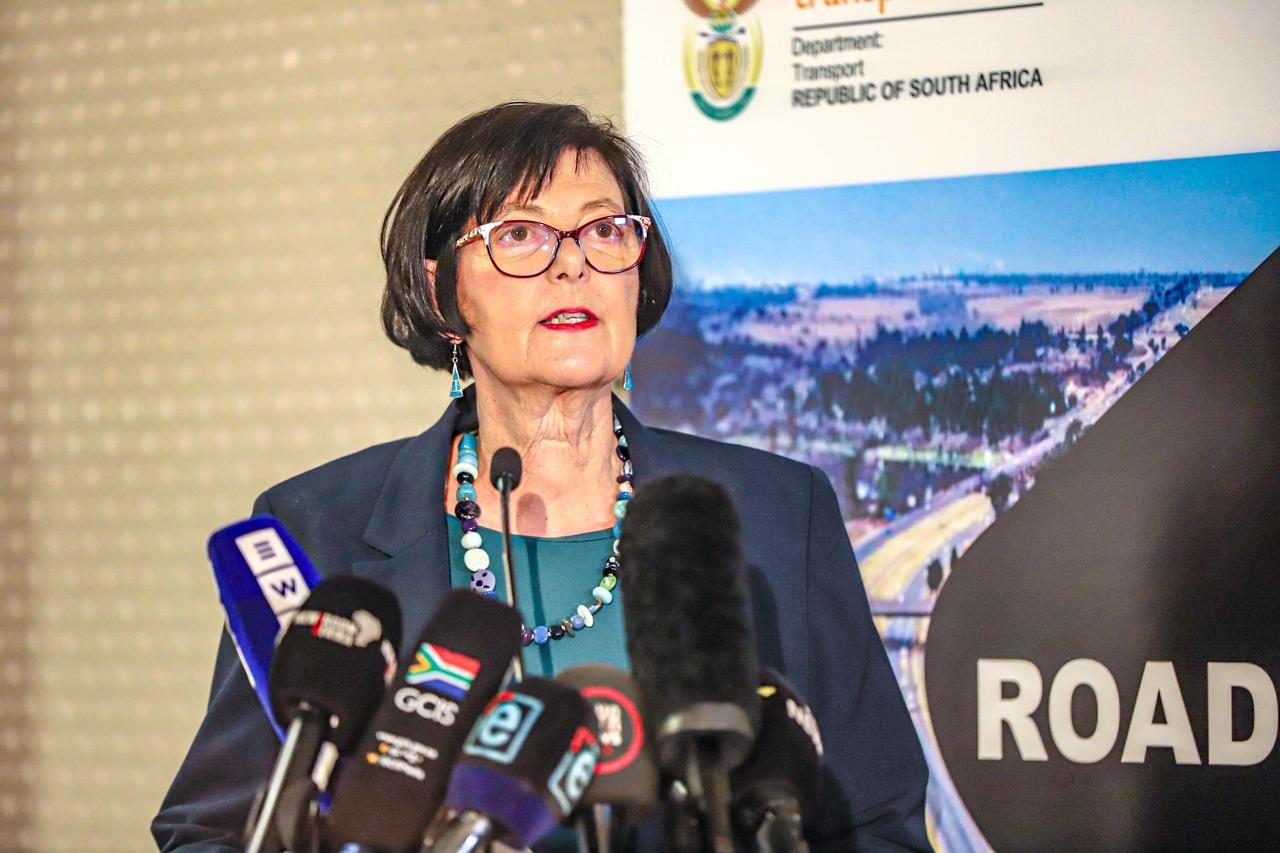
“In order to meet our target of moving 42 million passengers per year and increasing air freight handling through the ACSA network of airports, the entity has allocated R 21,7 billion for infrastructure development,” Transport Minister Barbara Creecy said.
She made her remarks on Monday, 7 July 202, in her Keynote address opening the 43rd Annual Southern African Transport Conference and Exhibition (SATC).
“This will improve facilities for passenger safety and comfort, over the medium term, and the building of a new freight terminal at OR Tambo International Airport.
“In addition, we are fast-tracking projects to ensure the reliable availability of jet fuel to all airlines at all our airports, as well as the general upkeep and upgrading of the facilities and technologies at each of our airports to improve both security of passengers and cargo, as well as convenience of airport users.”
Minister Creecy said the contribution of our State-Owned Airline, SAA, to SA’s GDP was confirmed by the recent study by Oxford Economics Africa.
According to this study, SAA contributed R9.1 billion to South Africa’s GDP in 2023/24, a figure projected to more than triple to R32.6 billion by 2029/30.
“Over the same period, the airline’s operations are expected to support 86,700 jobs, up from the current 25,000, demonstrating their growing role as a national employer and economic catalyst,” Minister Creecy said.
“SAA is pursuing a bold route expansion to strengthen its regional and global footprint.”
New regional routes from Johannesburg and Cape Town aim to boost intra-African connectivity, supporting tourism and trade.
The airline has begun a measured fleet expansion to meet growing demand, reinforcing its role as a connector of economies across the continent and beyond.
Minister Creecy said with unencumbered assets and renewed profitability, SAA was well-positioned to drive economic value through expanded international services, job creation, and increased contributions to tourism and trade.
Earlier, the transport minister said the aims and objectives of this Conference were aligned to the strategic priorities of the 7th Administration namely to promote inclusive economic growth and create jobs; to maintain and optimize the social wage, and to build a capable and ethical state.
“We all understand that an optimally functioning transport system is a cornerstone requirement for the achievement of all three objectives,” Minister Creecy said.
“This will require that the integrated transport system of the country be planned, designed, constructed, operated, and maintained in such a manner that long-term economic growth and development of South Africa can be achieved and sustained.”
The minister said the Department’s 16 SOEs and entities operate in an environment that is not of “our choosing”.
Accordingly, this will require leadership and foresight that prioritise the interests of our country and its people.
“Prompt execution of reforms in the logistics sector, along the total value chain, from pit-to-port and from manufacture-to-consumer, is essential to address and reduce the risks present in both our global and domestic environments,” Minister Creecy said.
“To give guidance to this huge ecosystem and focus the work of all of our entities on a common programme to improve our passenger, freight and logistics system over the next four years, we are guided by the following six clear targets.”
- The first is to ensure that by 2029, 250 million tons of freight are carried on the Transnet network per annum.
- The second is to improve the speed at which we load and unload ships to the international benchmark of 30 gross crane movements per hour.
- The third is to ensure our passenger rail system provides safe, reliable, and affordable transport to workers and their families. We aim to ensure 600 million passenger journeys per annum by 2030. 3
- The fourth is to boost the contribution of aviation to tourism, economic development, and job creation. We expect 42 million passengers per annum to move through the ACSA network of airports by the end of this political term.
- The fifth is to move 1.2 million tons of airfreight through the ACSA network of airports per annum by the end of this political term.
- The sixth is to ensure greater safety on our roads and reduce the devastating toll road accidents have on lives and livelihoods. We aim to reduce road fatalities by 45% by 2029 so we reach the UN target of halving road fatalities by 2030.
The minister said fundamental to the reform program “is our intention” to re-establish rail as the backbone of transport for people and goods.
“Since we embarked on the journey to restore passenger rail services nationwide, I am proud to share that PRASA had by the end of May 2025 successfully commissioned 35 out of 40 passenger corridors.”
Prasa has achieved an unaudited figure of 77 million passenger journeys for the last financial year and is predicting 116 million passenger journeys for the 25/26 financial year.
“Our competitive pricing model for commuter passengers will ensure that working-class communities take advantage of our offerings,” Minister Creecy said.
“Our freight rail reform programme is informed by the approved White Paper on the National Rail Policy of 2022 and complemented by the National Freight Logistics Roadmap of 2023.”
The Roadmap for the Freight Logistics System in South Africa clarifies that strategic infrastructure such as rail lines and ports will remain in public ownership, as assets belonging to the South African people.
“To this end, we must assure the country that we will do all within our power to rebuild and modernise the capabilities, operational effectiveness, and competitiveness of our state-owned freight logistics operator,” the minister said.
“The condition of our national roads and the feeder routes that connect with them remains a cause for concern in the public domain.
“Accordingly, over the past year national government, through the agency of SANRAL has at the request of our Provincial Premiers taken over 3 099 kilometers of provincial roads.”
SANRAL has reprioritised within the existing maintenance and capital allocated funding so that these roads are serviced through the Route Road Maintenance Programme.
“While I understand much more work needs to be done to ensure all provincial and municipal roads are in good condition, it is simply not possible for SANRAL to take on further upgrades at this time,” Minister Creecy said.
“At MINMEC on Friday, we committed to undertaking a review of road maintenance financing across all spheres of government.
She added: “While this review is in process, we must ensure existing budgets given to provincial and municipal governments are effectively spent and not returned to the National Treasury.
“We are currently strengthening our oversight role in the execution of concurrent functions we share with provincial governments through the management of conditional grants.”
Minister Creecy said, importantly, the department has prioritised R94 million over the medium term to provide technical support to provincial road departments to ensure conditional grants were effectively spent on road maintenance.
The taxi industry is responsible for transporting over 85 percent of all commuters.
Accordingly, formalising the industry and rooting out criminality and irregular operations remains a key focus.
“In this regard, in line with other economic sectors, existing taxi associations have a fundamentally important role to play in self-regulation and governance,” the minister said.
To make the taxi industry more financially viable, the government has committed to working with the banks and vehicle manufacturers to de-risk loan financing on new vehicles.
Part of this process involves developing a Standard Operating Procedure to ensure uniformity in the issuance of operating licences.
It is of critical importance that the duration of vehicle licences aligns with the loan repayment period for new vehicles.
“Road accidents remain a massive drain on our economy and deprive any families of their loved ones,” Minister Creecy.
“It is also important to acknowledge today the excellent co-operation we enjoy amongst national, provincial, local government, and civil society on reducing road accidents.
“I am pleased to report that our average 9 percent annual decline in accidents and fatalities is holding.”
The minister said to reduce deaths further, “we must work together” in a focused and consistent manner to tackle the high pedestrian fatality rate with consistent community outreach and education among those who live adjacent to, and cross, major roads.
The transport sector contributes significantly to national Greenhouse gas (GHG) emissions, and it is also vulnerable to negative climate impacts on infrastructure, which affects transport logistics and its value chain.
“In the previous financial year, the department initiated a process of revising the Green Transport Strategy as well as developing the Sector’s Just Transition Plan, which will see the sector transitioning to a low-carbon and climate-resilient economy and society,” recalled the minister.
“The Department’s Green Transport Strategy will include investing in green energy infrastructure; promoting the uptake of alternative fuels such as 10 biofuels and green hydrogen; extending the rail network to provide alternative public transport.
“A fully integrated transport system lies at the heart of any nation’s development.
“It is the artery through which progress flows, connecting communities, facilitating trade, and enabling access to opportunities.
“Our responsibility, as role players in the transport sector, is immense.
“We hold the key to unlocking the full potential of our nation’s economy and ensuring that no citizen is left behind.”