
The so-called Government of National Unity (GNU) is increasingly showing signs of disentanglement.
What was sold as a rational, inclusive political solution to South Africa’s fragmentation has now become a battleground of political sabotage, legal threats, ideological backstabbing, and administrative stagnation.
Week in and week out, the GNU plays host to a political game where the African National Congress (ANC) and Democratic Alliance (DA) chase each other, all the while lashing out with a venomous snake of mistrust and opportunism.
What may appear as political theatre, fit for media headlines and press conferences mirrors the instability we’ve seen in other coalition governments across Africa.
This dysfunction comes at a steep cost as it stalls service delivery, delays decisive policy action, and derails any coherent agenda for economic development and job creation.
At its core, this chaos is not accidental, it is deeply rooted in ideological posturing, power dynamics, and battles over resource control.
And at the very end of this destructive chain reaction are the people, ordinary South Africans facing rising unemployment, deepening poverty, worsening inequality, and a growing sense of disillusionment.
While this makes good small talk in buses, taxis, and trains, the impact of service delivery neglect goes deep and threatens the fibre of development.
While the Minister of Basic Education Siviwe Gwarube continues to divide the country with her approach to the BELA Bill, alienating key stakeholders in the process, her political home the DA threatens the President with legal action over the implementation of the National Health Insurance.
A leaked memo in July 2025 revealed that the DA refuses to support economic recovery plans involving state-owned enterprises, and threaten to reject key departmental budgets.
Helen Zille has gone so far as to lay criminal charges against Minister of Higher Education Dr. Nobuhle Nkabane, while DA federal leader John Steenhuisen refuses to attend oversight committee meetings.
The GNU has created a climate of political paralysis, policy confusion, and elite finger-pointing.
Ironically, it now reflects the very kind of “chaos” the DA previously warned would result from an ANC-Economic Freedom Fighters (EFF) coalition, a claim now fully contradicted by evidence on the developments of Tshwane.
In the City of Tshwane, a local coalition government formed between the ANC, EFF, ActionSA, and other smaller parties has, for the past nine months, demonstrated the potential of what true coalition governance can look like when involved parties understand the massage of the electoral outcome.
The voters were not convinced that any political party deserved majority rule.
This understanding commits the executive in the City of Tshwane to centre their mandate around the community itself.
Unlike the GNU, Tshwane’s multiparty coalition is not anchored in ideological stubbornness, but rather in a deliberate balancing of power and a shared commitment to local governance and service delivery.
Herein, political parties are compelled to reckon with their own policies, reflect on the lessons of the electoral outcome, and recognise that service delivery is not a favour, it is the frontline through which they must earn public trust and orient communities around their political vision.
In Tshwane, coalition politics is not reduced to drama, but elevated to a practical platform for governance, where parties must demonstrate the relevance of their party policies through real, measurable improvements in people’s lives.
One such example is the Department of Health, under MMC Tshegofatso Mashabela, which has successfully extended clinic operating hours towards 24 hours in Olievenhoutbosch – a poor, densely populated area in Pretoria South.
This initiative brings to life the EFF’s founding policy vision for accessible 24-hour healthcare and proves that progressive policy is not impractical—it simply requires political will.
More importantly, it signals a deliberate shift from political posturing to responsible governance, where the lives of residents take precedence over dogmatic bureaucratic sentiments that seek to discourage transformation.
Further still, the City of Tshwane Council has, through its revitalisation strategy, taken bold steps to unlock city-owned infrastructure for economic empowerment.
In the June 2025 council sitting, the Council adopted the lease of municipal office space and a skills centre in Nellmapius, east of Tshwane.
While having adopted the public-private developmental strategy agenda over the months by leasing a number of city-owned properties on 30-year-plus leasing agreements.
This is not just a leasing transaction, it is a political and ideological milestone, aligning with the EFF’s Cardinal Pillar Number One: Expropriation of Land Without Compensation for Equal Redistribution.
Here, the state is assuming its rightful role as custodian of land, not selling it to the highest bidder, but using it strategically to drive industrialization, housing, training, and job creation.
These avenues ensure that the land remains publicly owned while delivering on the developmental mandate of local government.
As these initiatives prioritize revenue and service cost collections, this intervention reflects not only fiscal responsibility but also transformative intent.
It demonstrates that land is more than a capital asset, it is a tool for empowerment and inclusive growth.
The government of local unity might not be ideological cronies, but they recognise that local government must be the catalyst for local economic activity.
By prioritising skills development, revenue stability, and housing, the council of Tshwane identifies with public land responsibly, as tools to empower communities, stimulate local business, and bring the state closer to the people.
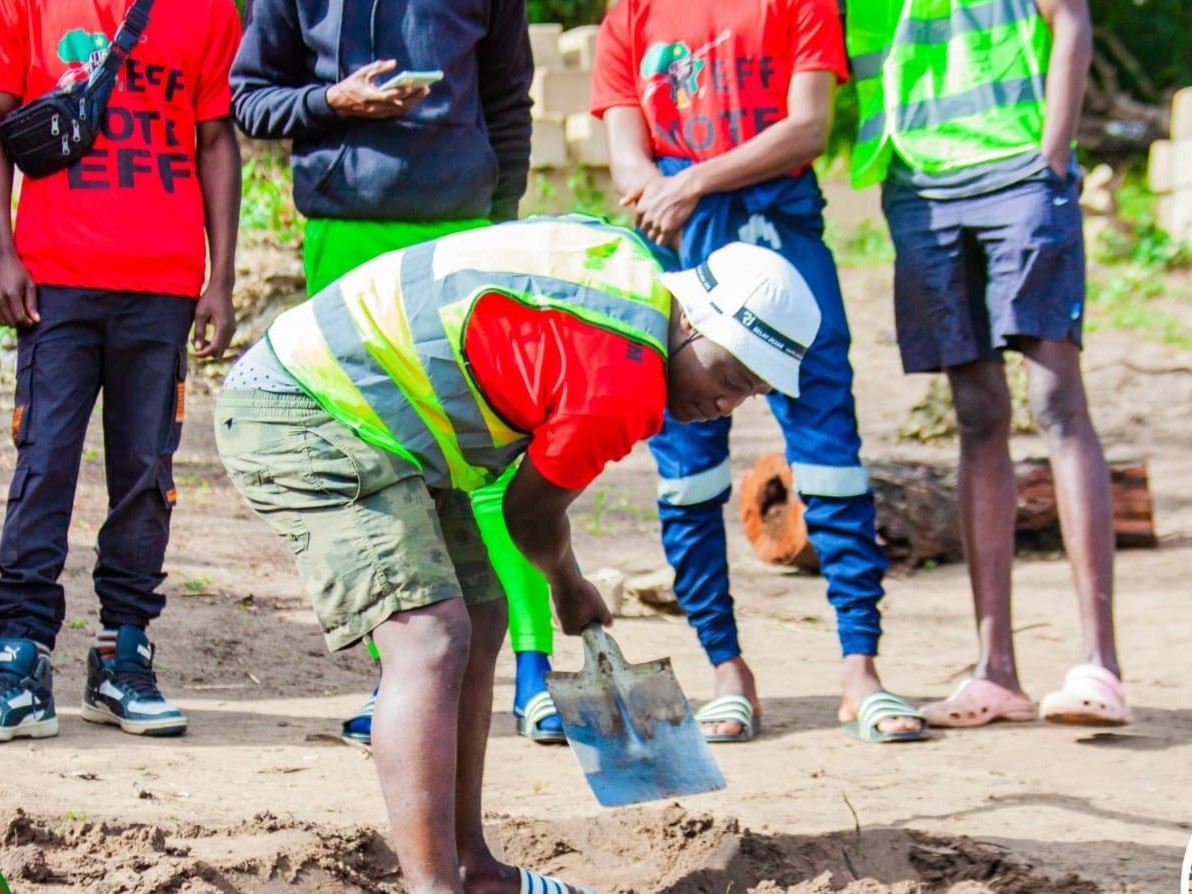
The Andries Tatane Clean-up Campaign, led by MMC Ramabodu through the Department of Environment and Agriculture, stands as a powerful example of a government that chooses responsiveness over red tape.
Originally rolled out by the Economic Freedom Fighters as a party programme of action, this initiative has evolved into a model of effective and accountable governance, rooted in community-cantered service.
By proactively addressing waste management and cleanliness in both central business areas and surrounding townships, the City of Tshwane is reaffirming its constitutional duty to the people.
This commitment reflects the spirit of Section 195 of the Constitution, which mandates that public administration must be governed by the democratic values and principles enshrined in the Constitution, including responsiveness, accountability, and a high standard of professional ethics.
The campaign shows that when the government is visible, hands-on, and directly engaged with community needs, it not only restores dignity but also rebuilds trust between the state and its citizens.
Meanwhile, the GNU continues to fumble through elite political chess moves, stuck in a cycle of legal threats, internal sabotage, and rhetorical grandstanding.
They can not even agree that polices such as BBEE are a cornerstone to address inequality, because certain parties are hellbent on serving their elite constituencies at the expense of a majority crippled by poverty.
*The writer of this article Lesego Mahlangu is a researcher at the City of Tshwane. She wrote this article in her personal capacity. The views expressed by Lesego Mahlangu are not necessarily those of The Bulrushes