Johannesburg – The biggest geomagnetic storm of the year is in progress, which could disrupt technological systems.
In a joint statement on Wednesday, 12 November 2025, the Department of Science, Technology, and Innovation and the South African National Space Agency (SANZA) stated that the Sun has been active over the past three days with three X-class (strong) solar flares observed.
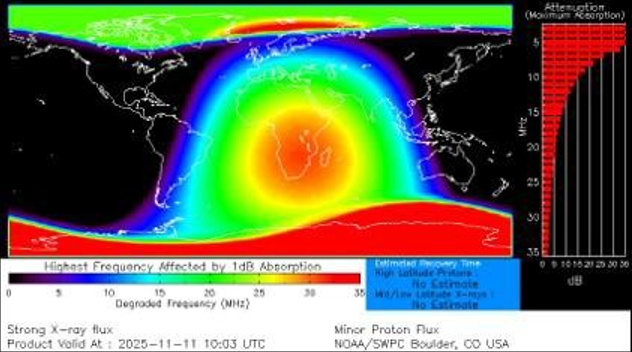
A solar flare is a sudden burst of light from the Sun and takes about 8 minutes to reach Earth.
The impact causes high-frequency radio blackouts in daytime regions.
X-class or strong solar flares were observed on Sunday, 9 November, Monday, 10 November, and Tuesday, 11 November 2025.
All three solar flares were accompanied by coronal mass ejections (CMEs), which are clouds of charged particles hurled into space.
“The two CMEs that were triggered by the solar flares on Sunday and Monday combined and impacted Earth from early this morning at about 01:30, causing G4 or Severe geomagnetic storm conditions,” the statement said.
Geomagnetic storm levels range from G1 (minor) to G5 (extreme).
“The coronal mass ejection associated with Tuesday’s X-class solar flare is expected to hit Earth later tonight or early tomorrow morning, resulting in continued geomagnetic activity,” the statement said.
“The SANSA Space Weather Centre expects storm conditions to reach between G1 and G4 levels, which will affect Earth and our technological systems up until 14 November 2025.
“Aurora is rarely seen in South Africa due to our distance from the polar region. However, photographers might want to keep their cameras handy.”’
A dark, cloudless night is needed to observe aurora.
Geomagnetic storms are caused by coronal mass ejections (CMEs), which are vast clouds of charged particles released during a solar explosion.
When these particles reach Earth and interact with its magnetic field, they can trigger geomagnetic storms.
These storms are responsible for producing the spectacular auroras visible near the North and South poles.
These storms also cause disruptions in technological systems such as Global Navigation Satellite Systems (GNSS) that affect aviation, maritime, and drone industries.
Other systems affected include communication, electrical power grids, and electronic infrastructure.
Geomagnetic Storm Classifications (G-scale)
The G-scale, used by space weather centres globally, categorises geomagnetic storms based on their intensity and potential impact. It ranges from G1 (minor), G2 (moderate), G3 (strong), G4 (severe), and G5 (extreme).
Monitoring and Tracking space weather
SANSA said it monitors the impact of the storm as it arrives at Earth through a network of ground-based instruments over the African continent, the Southern Ocean, and Antarctica.
SANSA works with space weather centres across the globe to monitor these storms.
“There is no way to prevent geomagnetic storms from impacting Earth; however, industries working with these technological systems can implement mitigating steps to minimise the impact,” the statement said.
For more information on daily space weather conditions, visit https://spaceweather.sansa.org.za/