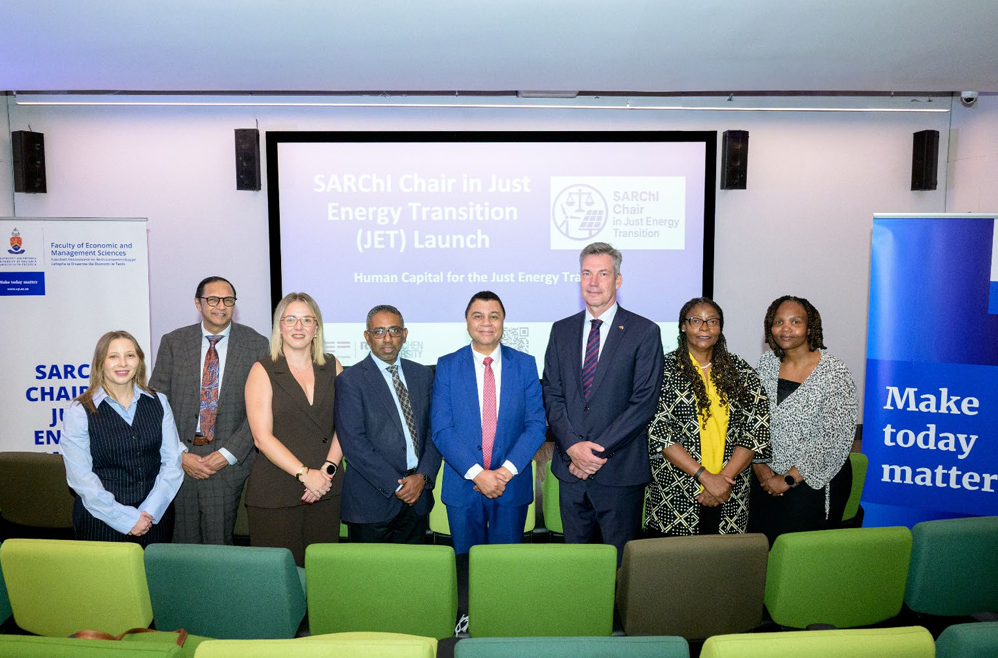
Pretoria – The University of Pretoria (UP) has launched the South African Research Chairs Initiative (SARChI Chair) in Just Energy Transition, positioning the institution at the centre of one of the most consequential economic and social transformations.
Led by Professor Roula Inglesi-Lotz and developed in partnership with RWTH Aachen University in Germany, the Chair strengthens South Africa’s capacity to generate rigorous, policy-relevant research that responds to the realities of energy transition in an unequal, carbon-intensive economy.
Energy transition is often framed in technical terms, focused on megawatts, emissions trajectories, and investment volumes.
Yet for societies undergoing structural change, it’s experienced far more personally, through electricity prices, job security, skills demand, and the credibility of public institutions.
The SARChI Chair is designed to engage these dimensions, placing people, work, and governance at the centre of energy systems research.
“The just energy transition is not a single policy choice or technological fix,” Prof Inglesi-Lotz said at the launch.
“It’s a process of structural transformation that affects households, workers, firms and institutions simultaneously.
“The purpose of this Chair is to generate evidence that helps decision-makers navigate that complexity in a way that is both economically sound and socially just.”
South Africa’s energy transition unfolds under uniquely urgent conditions.
The country must decarbonise an electricity system dominated by coal while simultaneously addressing energy insecurity, fiscal pressure, unemployment, and entrenched inequality.
At the same time, global climate commitments, technological shifts, and international finance shape domestic choices, constraining what’s possible and amplifying the cost of delay.
These realities demand research that moves beyond abstract modelling to grapple with institutional capacity, political economy, and distributional outcomes.
The Chair’s bilateral structure reflects this global interdependence.
RWTH Aachen University is one of Europe’s leading technical universities, internationally recognised for excellence in engineering, applied sciences, and energy systems research, with deep links to industry and policy processes in Germany’s own energy transition.
The partnership brings together two institutions working from different starting points, yet confronting a shared challenge: how to transform energy systems while maintaining economic stability and social trust.
Working across Pretoria and Aachen enables comparative analysis that is both analytically rigorous and practically grounded.
Germany’s experience with industrial decarbonisation, grid expansion, and long-term planning offers valuable insight, while South Africa’s context foregrounds questions of justice, affordability, and development. Together, the partnership rejects one-size-fits-all solutions in favour of context-sensitive transition pathways.
The Chair’s research agenda is deliberately multidisciplinary.
It integrates energy systems economics, labour market analysis, industrial structure, social outcomes, and institutional coordination.
Core research questions include how different transition pathways affect employment and prices; how costs and benefits are distributed across income groups and regions; how skills constraints shape feasible transition options; and how policy coherence influences implementation.
These questions are not treated as abstract problems, but as real constraints facing governments, firms, and communities.
UP Vice-Chancellor and Principal Prof Francis Petersen emphasised the centrality of human capital in addressing these challenges.
“The theme of this launch, ‘Human capital for the just energy transition’, reflects a fundamental truth,” he said.
“Without the right skills, institutional capability, and social inclusion, the transition will not be sustainable.
“Universities have a responsibility to ensure that knowledge creation translates into social and economic value.”
Capacity development is therefore a cornerstone of the Chair.
The initiative will support master’s and doctoral students, postdoctoral researchers, and early-career academics with co-supervision and exchange opportunities between UP and RWTH Aachen.
Beyond academic training, the Chair is engaging with public institutions and skills authorities to better understand workforce needs arising from energy system restructuring.
Particular focus is being placed on coal-dependent regions such as Mpumalanga, where reskilling and economic diversification are essential to mitigating transition risks.
From a government perspective, the Chair arrives at a critical moment. Director-General of the Department of Electricity and Energy, Subesh Pillay, described it as an investment in national capability.
He emphasised that justice in the energy transition must be tangible, reflected in job quality, the affordability of energy services, and the protection of vulnerable households.
Justice, he argued, also depends on transparency and institutional credibility, as public trust erodes when decisions are opaque or poorly communicated.
Pillay further noted that interdisciplinary research plays a vital role in moving from aspiration to execution.
Constraints such as grid capacity, municipal distribution challenges, and the cost of capital cannot be addressed through advocacy alone.
Evidence that integrates economics, engineering, and social realities is essential to making difficult trade-offs visible and manageable.
The SARChI Chair aims to extend its impact beyond academic publications.
By embedding research in policy-facing processes, convening stakeholders around evidence, and co-producing knowledge with practitioners, the Chair seeks to strengthen the institutional foundations of a socially durable and economically viable energy transition.
For Prof Inglesi-Lotz, the success of the transition will ultimately be measured not only by emissions reductions, but by whether people experience it as fair, credible, and inclusive.
“The just transition does not happen to people – it happens with people,” she said.
“This Chair exists to help make that possible.”