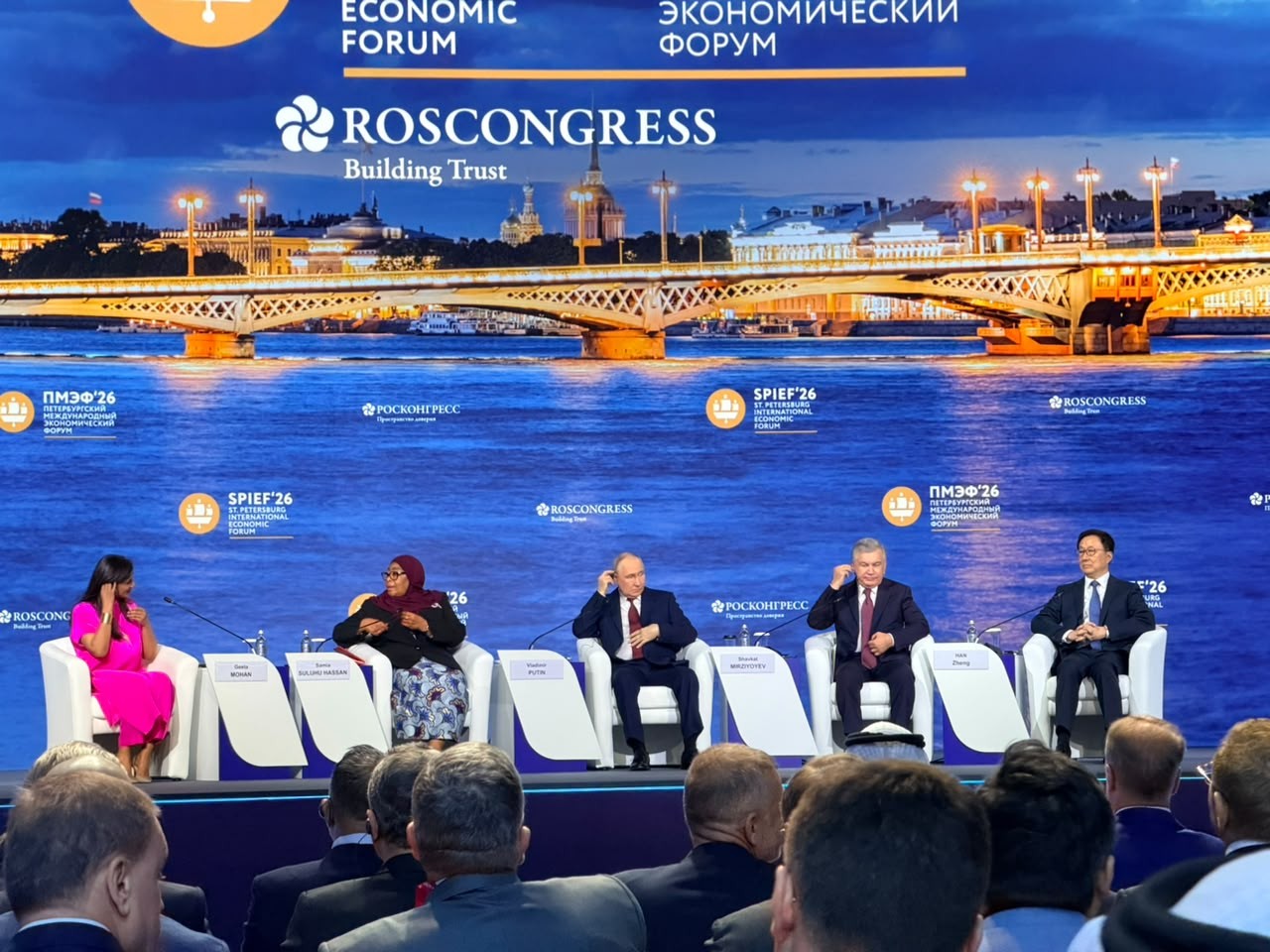
Moscow – The St. Petersburg International Economic Forum (SPIEF) 2026 unfolded in early June against a backdrop of drone strikes and geopolitical tension, serving as President Vladimir Putin’s platform to project Russian resilience and outline a vision for a post-Western world order.
Attended by around 20 000 participants from over 130 countries, the event—often called “Russia’s Davos”—highlighted Moscow’s pivot toward the Global South, BRICS expansion, and partnerships with nations like Iran, while Putin delivered pointed messages on the war in Ukraine and NATO.
(Source: aljazeera.com)
In his keynote plenary address and subsequent Q&A with international media, Putin framed the global economy as undergoing an irreversible shift toward multipolarity.
He declared that BRICS nations now account for a larger share of global GDP (by purchasing power parity) than the G7, a lead that continues to widen as the Global South drives growth.
Putin praised deepening ties with China, India, and new BRICS members, including Iran, positioning the bloc as the engine of future trade, national currency settlements, and alternative financial mechanisms bypassing Western dominance.
(Source: facebook.com)
BRICS and Iran in Focus
The inclusion of Iran as a full BRICS member underscored Moscow’s strategic alignment with Tehran.
Discussions at SPIEF touched on implementing a comprehensive strategic partnership treaty between Russia and Iran, covering trade, energy, and technology.
This comes amid broader regional volatility, with Russia offering diplomatic support to Iran while navigating the implications of conflicts involving Israel and the U.S.
Putin used the forum to burnish Russia’s image as a reliable partner for non-Western states, even as BRICS showed limited unity on some crises.
(Source: forumspb.com)
On the economic front, Putin touted Russia’s adaptation to sanctions, highlighting domestic investment, technological sovereignty (including AI), and redirected trade flows.
Agreements worth trillions of rubles were signed, predominantly with partners from Asia, Africa, and Latin America.
Yet the forum’s atmosphere was overshadowed by security realities: Ukrainian drones struck energy and military sites in the St. Petersburg area just as delegates arrived, a stark reminder of the war’s reach into Russia’s rear.
(Source: theguardian.com)
The Ukraine Conflict in Putin’s Narrative
Putin devoted significant attention to what Russia calls the “special military operation.”
He claimed Russian forces were making steady advances—citing thousands of square kilometers gained—and portrayed Ukraine as suffering catastrophic manpower shortages.
Moscow, he suggested, remains open to a settlement based on previously discussed frameworks, placing the onus on Kyiv and its backers.
He criticized Western distraction by other crises, implicitly referencing Middle East developments, as reducing focus on Ukraine.
(Source: youtube.com)
The speech and Q&A reinforced Russia’s long-standing red lines: no NATO membership for Ukraine, territorial realities on the ground, and “denazification” and demilitarisation goals.
Putin denied any Russian intention to attack NATO countries, dismissing such talk as “rubbish,” while warning that the alliance’s expansion and nuclear-sharing practices heighten risks.
He framed the conflict as part of a broader Western proxy effort against Russia, now faltering.
(Source: reuters.com)
Drones Reshaping the Battlefield Amid Manpower Strains
A defining element of the ongoing war, increasingly evident in 2026, is the transformative role of unmanned aerial vehicles (UAVs).
Both sides have industrialised drone production, but the dynamics favor attritional strategies that mitigate—or exploit—manpower shortages.
(Source: cnn.com)
Russia has relied on massive swarms of Shahed-type and other drones combined with missiles to exhaust Ukrainian air defenses and target infrastructure.
Ukrainian forces, facing recruitment challenges and high casualties, have turned to long-range drone strikes deep into Russian territory.
These operations have hit oil terminals, airfields, and naval assets—demonstrated dramatically by strikes near St. Petersburg during SPIEF—disrupting logistics, forcing Russia to disperse assets, and raising defense costs.
(Source: mickryan.substack.com)
Analysts note that drones allow Ukraine to project power asymmetrically, compensating for ground force limitations.
FPV drones, glide bombs, and maritime UAVs have inflicted significant equipment losses and forced tactical adaptations.
For Russia, despite reported recruitment drives and high casualties (with some estimates of monthly losses in the tens of thousands earlier in the year), mass drone and artillery use enables continued pressure with fewer exposed infantry assaults in certain sectors.
However, Ukrainian deep strikes complicate Russian force generation and sustainment.
(Source: engelsbergideas.com)
Putin announced plans to further bolster Russian air defenses in response to these incursions.
The drone war has evolved into a contest of industrial scale, electronic warfare resilience, and innovation, with both militaries investing heavily in unmanned systems.
This technological shift underscores the manpower-intensive nature of traditional advances.
Russia’s grinding offensives in Donbas come at a steep human cost, while Ukraine leverages drones to strike rear areas and preserve lives where possible.
(Source: apnews.com)
Broader Implications
SPIEF 2026 illustrated Russia’s dual track—economic reorientation abroad and determination to prosecute the Ukraine campaign on its terms.
Partnerships with BRICS and Iran offer sanctions evasion routes, energy markets, and diplomatic cover.
Yet challenges remain
Western sanctions’ long-term bite, the need to replace lost markets, and the resource drain of war.
NATO, for its part, continues to support Ukraine while enhancing its own deterrence, viewing Russian actions as a systemic threat.
Putin’s assurances of non-aggression toward the alliance coexist with warnings that escalation could spiral.
As the forum concluded, Putin’s message was clear: Russia sees itself as a cornerstone of a rising multipolar order, undeterred by conflict or isolation attempts.
The war in Ukraine, reshaped by drone swarms and manpower realities, remains the central test.
Whether diplomatic openings—potentially involving third parties—materialise, or attrition continues, will define the coming months.
SPIEF showcased Moscow’s confidence in outlasting pressure, but the smoke over St. Petersburg served as a visceral counterpoint to claims of unchallenged control.
(Source: specialeurasia.com)
Disclaimer: This article was compiled using the AI tool Grok on X and may contain inaccuracies