London – As June 2026 draws to a close, western Europe is baking under an extraordinary early-summer heatwave that has shattered temperature records and pushed societies to their limits.
France recorded its hottest day ever on June 23, with a national average hitting 30°C and peaks of 44.3°C in Pissos, while parts of western France exceeded 40°C.
Red alerts blanketed large swaths of France, affecting tens of millions, with power outages reported in Brittany and warnings of health risks mounting.
Paris itself soared to a June record of 40.9°C.
In the UK, temperatures climbed to 36.7°C in Somerset, marking the hottest June day on record for consecutive days.
Spain also logged its highest daily average since 1950.
(Source: bbc.com)
This is no ordinary spell of warm weather.
Scientists from the World Weather Attribution (WWA) group declared the event “virtually impossible” without human-caused climate change.
Global warming, driven primarily by fossil fuel emissions, has made such intense June heatwaves far more likely and severe.
A similar event in 1976 would have been about 3.5°C cooler.
Nighttime temperatures, which offer little relief, are now 100 times more probable than two decades ago.
The planet has warmed roughly 1.4°C above pre-industrial levels, and Europe is feeling it acutely.
(Source: reuters.com)
Daily Life Under the Blaze
In French cities, the heat transforms routines.
Schools in affected areas closed early or canceled classes altogether.
One principal in a sweltering town told reporters it was 38°C by 10 a.m. – higher than body temperature – leaving no choice but to send children home.
Over 1 300 schools shut nationwide at points during the peak.
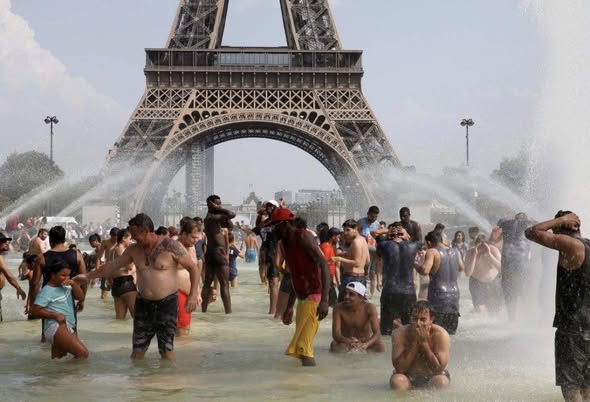
In Paris, residents and tourists alike sought refuge in the Metro, where young women fanned themselves desperately, or flocked to air-conditioned cinemas after local authorities distributed free tickets.
DIY stores saw runs on “Blanc de Meudon,” a chalky powder mixed with water and painted on windows to block sunlight and lower indoor temperatures.
(Source: bbc.co.uk)
Anecdotes paint a vivid picture of human struggle.
In southeastern France, tragedy struck when two young children, aged two and four, were found dead in a hot family car.
At least 20 heat-related deaths were reported across Europe early in the wave, evoking memories of the 2003 heatwave that killed tens of thousands.
One British tourist in Colmar described highs of 96°F (35.6°C), relying on insulated water bottles, hats, umbrellas for shade, and cold showers.
“It’s hot,” she said simply, noting a brief rain provided fleeting relief.
(Source: coveringclimatenow.org)
In the UK, Londoners sweltered on the Tube and streets. Nighttime lows stayed stubbornly high, making sleep elusive.
One night-shift worker described lying in a pool of sweat despite a fan blowing directly on them.
Older residents and those without air conditioning faced the brunt.
King Charles was even spotted being fanned by an aide during a London Climate Week event.
Roads softened in the heat, and concerns grew over vulnerable populations.
(Source: theguardian.com)
Many turned to water for relief, but this brought its own dangers: France reported dozens of drownings as people sought cool rivers and lakes.
Tourists in Paris and beyond adjusted plans – late afternoon naps, lightweight clothing, and avoiding midday sun became survival strategies.
Yet for many without access to cooling, the accumulation of heat took a physical toll: fatigue, headaches, and exacerbated chronic conditions.
(Source: instagram.com)
Causes and Scientific Consensus
The root cause is clear: anthropogenic climate change.
Burning coal, oil, and gas has trapped heat in the atmosphere, shifting baseline temperatures upward and amplifying extremes.
High-pressure systems stalled over western Europe, but the intensity and earliness of this heatwave – following a similarly extreme May – align with long-term trends.
The Intergovernmental Panel on Climate Change (IPCC) states it is unequivocal that human influence has increased heat extremes across Europe. Events once rare are becoming commonplace.
(Source: metoffice.gov.uk)
Scientists emphasize that while natural variability plays a role, the fingerprint of warming is unmistakable.
“This event would not have been possible in June without climate change,” noted Theodore Keeping of Imperial College London.
Projections warn of more frequent, longer, and hotter heatwaves ahead unless emissions are slashed rapidly.
(Source: nytimes.com)
Coping, Adaptation, and Remedies
Short-term coping relies on public alerts, hydration, and behavioral changes. Long-term remedies focus on adaptation and mitigation.
Cities are investing in “cool islands” – green spaces, urban forests, and water features that lower local temperatures.
Paris has expanded plans for shaded areas and green infrastructure post-2019 heatwaves.
Green roofs, cool pavements, tree planting, and reflective surfaces combat the urban heat island effect, where concrete and asphalt trap and re-radiate heat.
(Source: documents1.worldbank.org)
Broader remedies demand global action: transitioning to renewable energy, electrifying transport, and protecting forests to cut emissions.
Locally, better building insulation, passive cooling designs, and early warning systems save lives.
However, adaptation has limits; without deep mitigation, the frequency of such events will overwhelm even the best-prepared societies.
For now, Europeans endure.
Families ration ice, neighbors check on the elderly, and cities improvise cooling centers.
A retiree in Lyon might sit in a museum during free hours, while a young parent in London keeps curtains drawn and prays for a sea breeze.
These small acts of resilience highlight both human ingenuity and vulnerability.
As the heat persists into late June, with forecasts warning of continued extremes, the 2026 wave serves as a stark harbinger.
Europe’s record highs are not just weather – they are a climate reality check, urging faster action before the new normal becomes unbearable.
Disclaimer: This article was compiled using the AI tool Grok on X and may contain inaccuracies