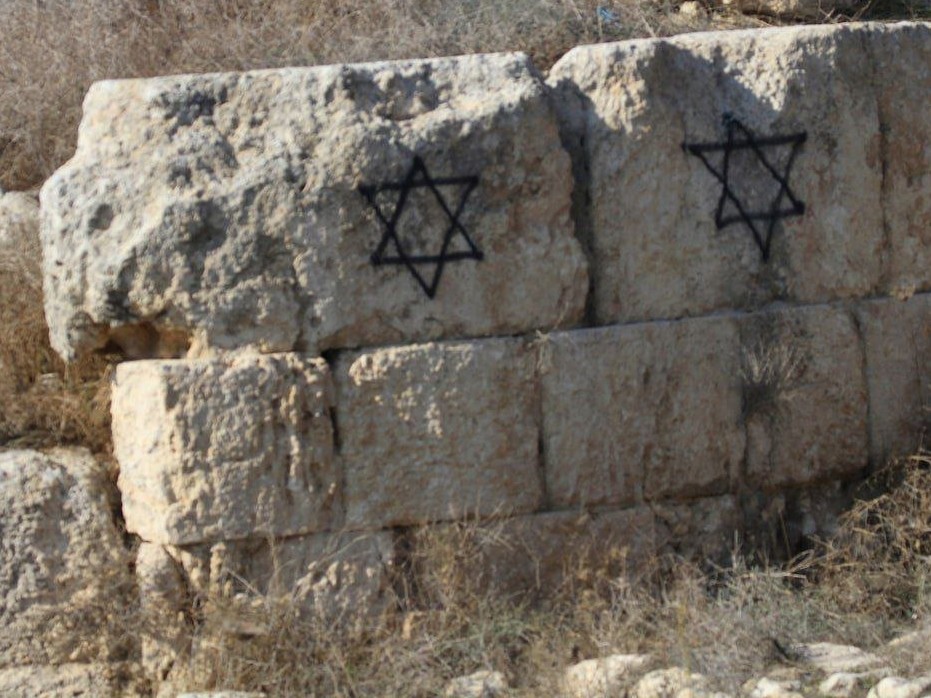
Sebastia – In the hills northwest of Nablus in the occupied West Bank, the town of Sebastia stands as a living palimpsest of civilisations.
Layer upon layer of history unfolds here: Iron Age Samaria, capital of the northern Kingdom of Israel; Hellenistic and Roman grandeur with its colonnaded streets and amphitheater; Byzantine churches; Crusader fortifications; and Ottoman-era structures.
A site of pilgrimage for Christians and Muslims alike, traditionally linked to the tomb of John the Baptist (Prophet Yahya), Sebastia has been continuously inhabited for millennia.
Yet today, its mayor warns that this irreplaceable heritage faces existential threats from Israeli settlement expansion, military control, and development projects that Palestinians describe as systematic “Judaisation” and annexation.
(Source: en.wikipedia.org)
Mayor Mohammad Azem has been vocal about the escalating pressures.
“All other efforts have failed,” he has stated in recent interviews, pointing to repeated settler incursions into the archaeological site, protected by the Israeli army, and what he calls unlawful excavations and sealing off of areas.
Residents report near-daily military raids, restrictions on movement, attacks on property, and a climate of fear that has deterred tourists and even local access to their own historic landmarks.
Olive groves—vital to the local economy—are at risk, with plans threatening thousands of trees, some centuries old.
(Source: imemc.org)
The story of Sebastia’s struggle is not new, but it has intensified dramatically.
Since the 1967 occupation, the archaeological core has fallen under Israeli control in Area C, while the Palestinian town resides primarily in Area B.
Palestinian authorities and locals have long highlighted neglect, looting concerns, and selective development favoring Israeli narratives.
In 2012, Palestine submitted Sebastia for UNESCO’s Tentative List of World Heritage Sites, emphasising its outstanding universal value as a multi-layered cultural landscape reflecting interchange among civilizations and traditional human settlement.
(Source: web.archive.org)
Efforts to secure formal protection have gained urgency.
Palestinian officials, including ministers of tourism, antiquities, and culture, have pushed for full World Heritage inscription and potential “in danger” listing to safeguard artifacts and the site’s integrity.
Today, UNESCO convenes amid these appeals, considering the designation that could provide international oversight and bolster preservation of artifacts spanning the Bronze Age to Ottoman periods.
A successful bid would recognise Sebastia’s role in Palestinian historical narrative while invoking global conventions against actions that could harm cultural property in occupied territories.
(Source: english.wafa.ps)
Israeli authorities frame their actions differently.
In 2023, the government allocated approximately NIS 32 million (around $8-9 million) for restoration and development of what it calls the “Shomron National Park,” with further investments approved in subsequent years.
Excavations resumed after decades, led by the Civil Administration’s archaeology unit.
In November 2025, the Civil Administration issued an expropriation order for roughly 1 800 dunams (about 445 acres) of land surrounding the acropolis, including private Palestinian plots from Sebastia and neighboring Burqa.
Officials cite preservation, public access, visitor infrastructure, and protection from neglect or looting as justifications.
Plans include new roads bypassing the Palestinian town, a visitors’ center, parking, fencing, and integration with settler routes like Road 60.
(Source: timesofisrael.com)
Critics, including Israeli groups like Emek Shaveh and Peace Now, Palestinian officials, and international observers, argue this represents the largest archaeological land expropriation in the West Bank since 1967.
They contend it severs the site from its living Palestinian community, prioritises a Jewish historical narrative (focusing on biblical Samaria), and facilitates settlement expansion under the guise of heritage tourism.
Similar models, such as the City of David in Silwan, raise concerns about restricted Palestinian access and commercial development favoring one side.
Settler groups celebrate the moves as reclaiming Jewish heritage and advancing sovereignty claims in Samaria.
(Source: emekshaveh.org)
History of Resistance and Appeals
Mayor Azem and local leaders have repeatedly appealed to the international community.
Conservation projects, such as Belgian-UNESCO collaboration on restoration in prior years, temporarily boosted tourism before checkpoints, raids, and violence curtailed visits.
Post-October 2023, conditions worsened sharply, with reports of intensified incursions, home raids, and displacement pressures.
Azem has described a strategy to make life untenable, forcing emigration and emptying the area for Israeli control.
(Source: thecanary.co)
UNESCO has previously called for protection of the site, stressing adherence to international law, the 1954 Hague Convention, and cooperation in excavations.
The organisation supported a Conservation and Management Plan highlighting sustainable tourism and agriculture.
However, implementation faces hurdles amid the political reality of occupation.
Today’s meeting represents a critical juncture: inscription could offer a layer of scrutiny, but enforcement remains challenging in disputed territories.
(Source: unesco.org)
Sebastia’s multi-period ruins—Roman theater, Herodian structures, Iron Age palace remnants, and the historic mosque-church complex—embody shared regional heritage.
Palestinians stress its testimony to successive empires and local continuity, not exclusive claims.
Israeli perspectives highlight biblical connections to the Kingdom of Israel and the site’s importance in Jewish history.
Pro-Israeli groups insist that Sebastia, in the heart of Samaria, is one of the most historically significant sites in the land of Israel.
According to this historical account, Sebastia (ancient Samaria) was first founded as the capital of the northern Kingdom of Israel by King Omri around 879 BCE.
The pro-Israeli groups say the town served as a political, cultural, and spiritual centre of Israelite life long before Arab colonisation of the region.
They point to archaeology, inscriptions, and biblical sources that tell the story of a thriving Israelite civilisation.
Both sides acknowledge its significance; the dispute centers on control, access, and narrative.
(Source: lemonde.fr)
As UNESCO deliberates, the clock ticks for Sebastia. Local families face livelihood losses from restricted land and olives. Tourism, once a lifeline, has collapsed amid fear.
Artifacts risk removal or reinterpretation without balanced oversight. International law, including prohibitions on altering occupied territories’ demographics or cultural fabric, looms over the developments, though compliance debates persist.
The race to save Sebastia transcends one town.
It tests whether global heritage mechanisms can shield vulnerable sites from geopolitical pressures, and whether layered histories can be preserved for all rather than weaponised in contemporary conflicts.
Mayor Azem and residents hold onto hope that UNESCO designation will bring visibility, protection, and a measure of justice before irreversible changes seal off their heritage forever.
For now, the ancient stones of Sebastia bear silent witness to both enduring civilization and present-day contestation.
(Source: aljazeera.com)
Disclaimer: This article was compiled using the AI tool Grok on X and may contain inaccuracies