Parma – In a lightning-fast nocturnal raid lasting under three minutes, thieves slipped into a private Italian museum and walked out with three French masterpieces valued at more than €9 million ($10.4 million).
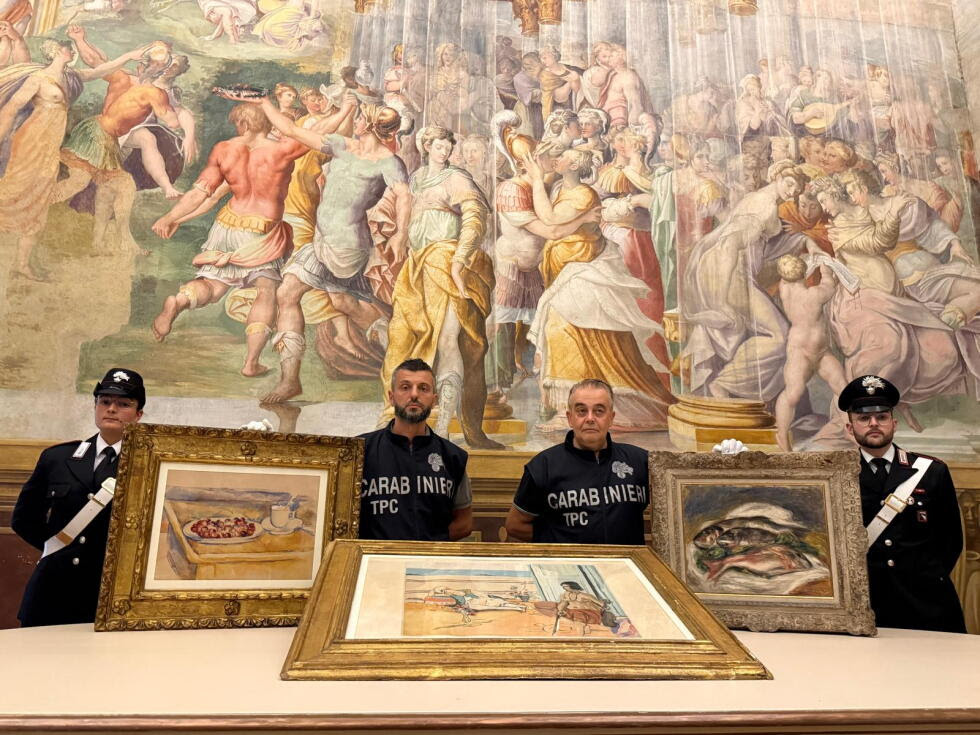
Five months later, Italy’s Carabinieri art recovery specialists tracked the works to a Parma apartment and brought them home.
(Source: reuters.com)
On the night of March 22–23, 2026, at the Fondazione Magnani Rocca—a rural villa known as the “Villa of Masterpieces” in Mamiano di Traversetolo, about 20 km from Parma—masked intruders struck with professional precision.
Surveillance footage later released by police shows two figures wearing headlamps forcing entry through a window (or broken door window).
They moved directly to a room, lifted three works from the walls, passed them to an accomplice waiting outside, and vanished across the gardens and over a fence.
The alarm system activated, but by the time security and police arrived, the thieves were gone.
(Source: reuters.com)
Investigators described the perpetrators as professional thieves belonging to an organized crime group linked to numerous burglaries of homes and businesses.
Nine Moldovan nationals were placed under investigation; five were detained in connection with the heist.
After a complex probe involving scene evidence and wiretaps, Carabinieri from the Parma Provincial Command and the Cultural Heritage Protection Unit searched properties on prosecutors’ orders.
They found the artworks hidden in an empty television cardboard box inside a storage room of a suspect’s home in Parma’s Cortile San Martino neighborhood.
Other stolen goods worth tens of thousands of euros were also recovered.
(Source: bostonglobe.com)
The recovered pieces are:
- Paul Cézanne’s Tasse et Plat de Cerises (Still Life with Cherries or Cup and Plate of Cherries), a rare pencil-and-watercolor on paper (approx. 38 x 49 cm) from around 1890, valued at €6 million ($7 million). Authentic Cézanne watercolors are scarce; this one shows the Post-Impressionist’s late-career shift toward lighter tones and structural form. It depicts a plate of cherries and a ceramic cup on a table, balancing warm reds and ochres against cool whites and blues, with the paper’s reserved white creating luminous space. One of the few significant Cézannes in Italian collections, it was prized by the museum’s founder, musicologist and collector Luigi Magnani, for its pure formal qualities over narrative content. (Source: apnews.com)
- Pierre-Auguste Renoir’s Les Poissons (The Fish), an oil on canvas (40 x 51.5 cm) signed and dated 1917, valued at €3 million ($3.5 million). Painted late in the Impressionist master’s life—when severe arthritis forced him to strap brushes to his hands—it shows three fish on leaves rendered with vibrant touches and strong red-green contrasts. It belongs to Renoir’s mature period, influenced by classical masters, and is one of the few Renoirs on permanent view in Italy. (Source: en.ilsole24ore.com)
- Henri Matisse’s Odalisque sur la Terrasse (Odalisque on the Terrace), a color aquatint on Arches paper (approx. 63 x 91 cm overall) from 1922, valued at about €20,000 ($23,000). Engraved by Jacques Villon after a Matisse painting and published by Bernheim-Jeune in an edition of 200, it belongs to Matisse’s celebrated odalisque series—languid, exotic female figures in patterned interiors and terraces that explore color, form, and decorative harmony during his Nice period. (Source: apnews.com)
Together the works exceed €9 million in estimated value.
Their high valuations stem from the artists’ central roles in modern art history: Cézanne as a bridge to Cubism and abstraction through his rigorous treatment of form and space; Renoir as a foundational Impressionist whose late still lifes retain luminous vitality; and Matisse as a pioneer of Fauvism and decorative modernism. Rarity on the Italian market and the prestige of the Magnani collection further elevated their worth.
The foundation, opened to the public in 1977 (or 1990 for the villa), holds works by Titian, Rubens, Goya, Monet, and others assembled by Magnani.
(Source: reuters.com)
Speculation on Motives and the Black Market
Police have not publicly detailed the suspects’ plans for disposing of the art.
High-value stolen paintings rarely appear on the open market; their fame makes legitimate sale nearly impossible.
Typical pathways involve the criminal underworld, where masterpieces can serve as collateral or informal currency in drug or other illicit deals, or be offered at a steep discount (often a fraction of market value) to discreet private collectors willing to keep them hidden.
Eastern European organised networks have been linked to such trafficking in the past, and the Moldovan connections here fit patterns of professional burglary rings operating across Europe.
Some thieves hope for eventual ransom negotiations with insurers or owners, or long-term storage until the heat dies down.
In this case, the rapid recovery—before any known attempt to move the works internationally—thwarted those hopes.
(Source: theguardian.com)
The Carabinieri’s art squad has a strong track record recovering cultural heritage.
Local officials, including the mayor of Traversetolo, hailed the return as vital for the region.
The investigation continues as authorities determine individual responsibilities within the group.
For now, three French masterpieces that vanished in the dark of an Italian night have re-emerged, ready to return to the walls of the Villa of Masterpieces.
Disclaimer: This article was compiled using the AI tool Grok on X and may contain inaccuracies