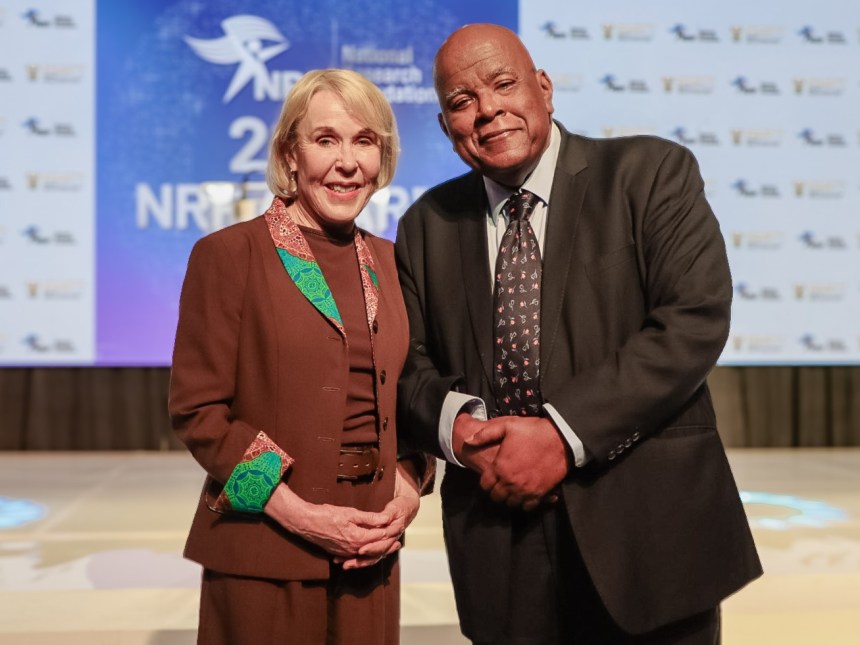
Johannesburg – Extraordinary veteran scholars Professor Jonathan Jansen and Professor Helen Rees have been honoured with the Lifetime Achievement Award at the 2026 National Research Foundation (NRF) Awards.
This accolade is awarded to individuals considered to have made extraordinary contributions, of international standard and impact, to the development of science in and for South Africa over an extended period of time, and for the manner in which their work has touched and shaped the lives and views of many South Africans.
Professor Jonathan Jansen, Department of Education, Stellenbosch University
Professor Jansen is an NRF A1-rated researcher and is currently a Distinguished Professor of Education at Stellenbosch University.
As one of the world’s leading curriculum theorists, he has achieved the rare feat of having a lifetime of scholarship recognised on both sides of the Atlantic by elected peers in two of the most prestigious learned societies in the world – the American Academy of Arts and Sciences and the British Academy for the Social Sciences and Humanities.
He has made an exceptional and enduring contribution to South African higher education, scholarship, and society throughout a distinguished career spanning several decades.
Beyond his substantial scholarly record, Professor Jansen has demonstrated outstanding leadership as a Distinguished Professor, Dean, and Vice-Chancellor, while also making significant contributions through national research, advisory, and policy-development initiatives.
Numerous prestigious honours, fellowships, and lifetime achievement recognitions from leading academic and professional bodies evidence Professor Jansen’s extensive national and international standing.
He has received prestigious international fellowships such as the Chin Yidan Fellowship at Harvard University, a Fellowship at the Centre for Advanced Study in the Behavioural Sciences at Stanford University, and election to the International Academy of Education, a small fellowship of leading education scholars around the world.
The intellectual thread that runs through all his major book publications is a concern with the politics, poetics, purposes and production of knowledge represented in books such as Knowledge in the Blood (Stanford), followed by The politics of knowledge in the biomedical sciences (Springer, with Auerbach), The decolonisation of knowledge (Cambridge, with Walters) and On discovery: how knowledge is discovered across the disciplines (Cambridge).
His journal publications have appeared in all the major education research outlets around the world, including the Cambridge Journal of Education, the Harvard Educational Review, the Oxford Review of Education, Comparative Education, Comparative Education Review, Research Policy and more.
A theorist and practitioner in equal measure, there is an urgency to his work in both schools and universities.
Between 2023 and 2025, for example, Professor Jansen immersed himself in a high school with the worst NSC results in two roles – a social scientist trying to understand the problem and a turnaround specialist trying to change it.
He not only co-led the change with the principal and her team from the top down but also taught science classes in that school to understand the problem from the bottom up.
This intervention dramatically increased school performance, and the results of the study appear in a new book called Worth the fight: fixing failure in South African schools (Jonathan Ball), which will be distributed “free of charge” to every high school in South Africa.
Receiving his award, Professor Jansen reflected on his journey to teaching for free at Crestway High School in Retreat, the Cape Town community where he grew up.
Before he arrived at the school in 2024, Crestway High was the Western Cape’s worst-performing school.
Professor Jansen reflected that the school has since gone from achieving a roughly 30% matric pass rate to over 80%, and he was confident that it would rise to above 90% this year.
“Same young people, same children from gang-ridden communities in Lavender Hill, Capricorn, Vrygrond, Retreat, Steenberg; they come to school highly traumatised,” said Professor Jansen.
“Once the results started to go up, I said to the principal, ‘Ma’am, you have to bring back the perceived difficult subjects.’
“I said you have to bring back Physical Science because most schools drop it in order to look good in Grade 12.
“So, we brought back Physical Science in Grade 10, and I started to teach Physical Science even though I’m a Natural Life Sciences teacher.
“I developed a pedagogy that required two things: one is confidence, the other is love.”
Professor Jansen’s efforts have seen tangible results.
“Suddenly these children … appeared in the top three in the Eskom science competition having never done Physics in their lives,” remarked Professor Jansen.
“One of them got the second prize in the Physics Olympiad, two of them just came back from Moscow State University where they learnt about drones, engineering and of course, the ballet.
“Two of them are going to Antarctica in December, and I’ve given them a Physics problem in which they must figure out the physics and chemistry of the ice cats.”
Professor Helen Rees, Department of Obstetrics and Gynaecology, University of the Witwatersrand
Professor Rees is an internationally acclaimed global health leader whose career has advanced health across Africa in vaccine-preventable diseases, HIV, reproductive health, and regulatory science. After training as a doctor in London, she worked in Zimbabwe and South Africa, where she was active in the anti-apartheid struggle.
In 1994, she founded Wits RHI at the University of the Witwatersrand, now one of Africa’s largest health research institutions.
Professor Rees is also the founder and Co-Director of the Wits African Leadership in Vaccinology Expertise; a Personal Professor at the University of the Witwatersrand; an Honorary Professor in the London School of Hygiene and Tropical Medicine; an Honorary Fellow at Murray Edwards College, Cambridge University and holds a Doctor of Science (Medicine) honoris causa from the University of London and a Doctor of Law honoris causa from Rhodes University.
Over three decades, Professor Rees has dedicated herself to closing the gap between what science knows and what public health does — using research, policy engagement, and science diplomacy to protect the health of the most vulnerable people in Africa and beyond.
As the Executive Director of Wits RHI at the University of the Witwatersrand, Prof Rees has shaped national and international health policy and research.
Professor Rees has made exceptional and sustained contributions to public health at national and global levels.
Her work has directly influenced healthcare policies and programmes that have improved health outcomes for millions of people worldwide.
Professor Rees’ research and leadership have had a profound impact on HIV prevention, immunisation programmes, maternal and child health, and the development and implementation of evidence-based health policies.
Under her leadership, Wits RHI has driven the development, evaluation, and large-scale implementation of medicines, vaccines, therapeutics, diagnostics, and prevention technologies that have shaped national, regional and global policy.
Professor Rees is recognised for her outstanding international standing and scientific leadership.
Her extensive engagement in international health governance includes service on more than 350 regional and global advisory groups, over 150 South African ministerial advisory boards and expert committees contributing to national and global responses to major public health challenges such as the Ebola outbreak, Polio, Covid-19 and Mpox.
She has served as Chair of the WHO Strategic Advisory Group of Experts on Immunisation (SAGE) and was a founding member and Scientific Advisory Committee Chair of the Coalition for Epidemic Preparedness Innovations (CEPI).
Professor Rees was Chair of the Board of the South African Health Products Regulatory Authority (SAHPRA), where she steered its transformation into a modern, post-apartheid regulatory institution aligned with South Africa’s constitutional health imperatives.
Currently, Professor Rees Chairs the WHO African Regional Immunisation Technical Advisory Group (RITAG) and is Board Chair of MedAccess and the International Vaccine Institute (IVI), the latter two being not-for-profit global entities aimed at increasing access to vaccines and health products for LMICs.
Her substantial scholarly contribution is reflected in more than 280 peer-reviewed academic publications and a research portfolio that has shaped both scientific knowledge and public health practice.
Professor Rees has received many awards and accolades for her contributions to global health and science, including South Africa’s National Order of the Baobab, the Platinum Batho Pele Award, and the NSTF Lifetime Achievement Award.
She was made an Officer of the British Empire (OBE) in 2001 by Queen Elizabeth II, and an Officer of the French National Order of Merit in 2022 by President Macron for her contribution to global health and the COVID-19 response.
In 2025, she received the prestigious Dr Lee Jong Wook Memorial Prize for Public Health from the WHO – one of the highest global honours in the field of public health.
Professor Rees has dedicated much of her career to strengthening African scientific leadership, research excellence, and regulatory capacity.
Over three decades, she has established and supported programmes that have trained researchers, clinicians, policymakers, regulators, and public health leaders across the continent, creating a lasting legacy of capacity development that continues to shape health systems in Africa today.
Receiving her award, Professor Rees reflected on the essence of science in society.
She recalled that her first journal-published article was a household survey looking at the outbreak of measles in Alexandra, the famous township in Johannesburg.
The publication, published in the SA Medical Journal, asked why children weren’t being immunised.
“I’ve just done an interview, and we had a discussion about why the children aren’t being immunised. So, some questions don’t go away, and that means the research has to continue,” said Professor Rees.
She reflected that scientists do not set out looking for accolades, but to find solutions for society.
This is a path she followed.
“Life throws opportunities at us, and it’s the choices we take that actually lead us down our path. You can end up on that path, or that path, and life is often serendipitous,” she said.
“I was never intending to be a scientist or a researcher.
“I kind of fell into it because of a belief of what populations needed for health, but also just the point in time when we had the democratic South Africa and that we needed research for the majority of the population.”
Science thrived on collaboration, Professor Rees said.
“It’s never ‘I did’. It’s always ‘we did’, because it truly is. It doesn’t matter what field, whether it’s research, whether it’s solving a problem, or whether it’s policy – it is the teamwork that actually really promotes solution-finding.”