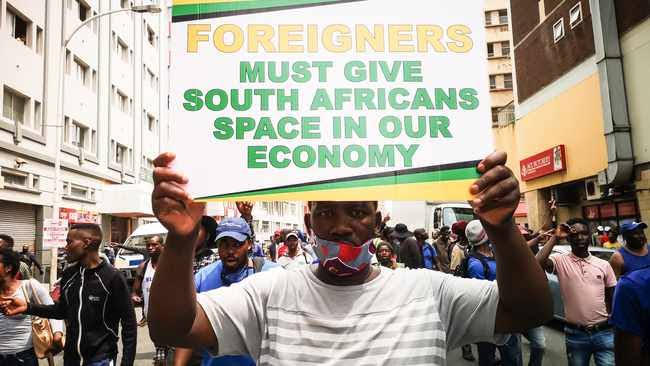
Johannesburg – Siyafana Sonke Action Campaign, which pushes back against xenophobia and anti-immigrant sentiment, has challenged claims that “foreign nationals rule the roost in workplace employment in entry-level jobs”.
Responding to the false claim, Siyafana Sonke said: “We note the Department of Employment and Labour’s statement of 12 November 2026, published under the headline ‘Foreign nationals rule the roost in workplace employment in entry-level jobs’”.
Siyafana Sonke further stated: “That headline is inaccurate, and its language is inflammatory.
“The department’s own figures do not show that foreign nationals dominate entry-level work.
“Its own Commission for Employment Equity shows the opposite: 98% of workers in South Africa are South African.
“Less than 2% are foreign nationals.”
Siyafana Sonke said that at a time when anti-migrant groups are mobilising in communities and outside workplaces, a government department “has a particular duty not to suggest that being foreign-born means being illegal, criminal or a thief of jobs”.
The anti-xenophobia campaign said the false claim headlined “foreign nationals rule the roost in workplace employment in entry-level jobs” wrongly suggests that being “foreign-born means being illegal, criminal or a thief of jobs”.
Siyafana Sonke said the false claim risks fuelling hostility and violence against people who are lawfully living and working in South Africa.
What the Department of Employment and Labour inspection figures actually show
● Most inspected workplaces employed no foreign nationals. Inspectors visited 168,766 workplaces. Only 21,371 of them employed any foreign nationals, which means 87% employed South Africans only.
● The numbers per workplace are small. Across the workplaces that did employ foreign nationals, the average is about 11 foreign workers per workplace. In wholesale and retail, it is about 6 per employer. The average is pushed up by commercial agriculture, where 46 533 foreign workers were recorded across just 1,205 employers.
● The total is a small share of the workforce. Even taken at face value, 231,850 people is about 1.4% of South Africa’s 16.8 million employed people. Even if every one of these jobs went to a South African, it would absorb less than 3% of the 8.6 million people who are officially unemployed.
What the figures do not show
The statement leaves out the information needed to support its claims:
● Legal status. The figures do not say how many of the 231,850 workers were undocumented and how many held work visas, permanent residence, spousal visas or asylum and refugee permits. Putting them all together creates the false impression that every one of these jobs is held unlawfully.
● Skill level. The Inspector-General says “most” of these are entry-level jobs, but the published figures do not break the workers down by occupation or skill level. The Department’s own top 10 sectors include financial services, education, manufacturing and mining, which employ many people in skilled and professional roles.
● South African workers at the same sites.
The statement does not say how many South Africans were employed at the inspected workplaces. Without that, nobody can tell whether foreign nationals make up 1%, 5% or 50% of those workforces.
● Methodology. As far as we can establish, the full report and its methodology have not been published, so the figures cannot be independently checked. An enforcement sample is not a survey of the economy IES inspections are not a random sample.
They respond to complaints and tip-offs, and they are often run as joint “blitzes” with Home Affairs and the police in sectors where non-compliance is already suspected, such as commercial farming, hospitality and retail.
“That is a legitimate way to enforce the law. It is not a legitimate basis for claims about the labour market as a whole,” Siyafana Sonke said.
“A sample chosen because foreign workers are expected to be there will, unsurprisingly, find foreign workers there.”
The department’s own Commission tells a different story
The department does not need to rely on inspection raids.
Its 26th Commission for Employment Equity (CEE) Annual Report, released this year, covers about 6.9 million workers employed by designated employers (those with 50 or more staff). It finds:
● Foreign nationals hold about 2% of all reported jobs. South Africans hold about 98%.
● At the unskilled level, foreign nationals make up 3.2% of workers. South Africans hold 96.8% of these jobs, about 30 for every foreign national.
● At the semi-skilled level, foreign nationals make up 1.7%. South Africans hold 98.3%, or about 58 for every foreign national.
● Foreign nationals are in fact better represented in senior management (3.3%) and top management (3.1%) than in semi-skilled work.
That is the opposite of the picture the headline paints.
The CEE data covers the formal sector and larger employers. It does not capture informal work or small businesses.
“But it is a full count of reported employment rather than a targeted sample, and it gives no support to the claim that foreign nationals ‘rule the roost’,” Siyafana Sonke said.
Lawbreakers are the employers who exploit workers
“When a farm, shop, or restaurant pays an undocumented worker below the National Minimum Wage, avoids registering workers for UIF and COIDA, or ignores health and safety rules, the employer is the one breaking the law,” Siyafana Sonke said.
“The worker is not ‘stealing’ a job. That employer is undercutting every worker, South African and foreign alike.”
Siyafana Sonke said the department’s own enforcement work shows how widespread this is.
In its first national blitz this year, only three of 114 workplaces inspected were fully compliant with labour laws. Labour rights do not depend on nationality.
“South African labour law protects all employees, and the Labour Court confirmed in Discovery Health v CCMA (2008) that this includes workers without valid work permits,” Siyafana Sonke said.
“Turning public anger toward workers rather than toward non-compliant employers lets those employers off the hook and weakens protections for everyone.”
Migration is normal and goes both ways
Employers hire people for their skills, experience, and ability to do the job.
Foreign nationals who work lawfully in South Africa need a valid visa or permit and the relevant qualifications.
“Migration is a normal feature of every economy, and it is a separate issue from crime. It also goes both ways. Close to a million South African-born people live abroad,” explained Siyafana Sonke.
The 2021 census of England and Wales counted 217 180 residents born in South Africa.
Australia counted 189 207 and the United States 123 461.
“If those countries treated South Africans the way this headline invites South Africans to treat foreign workers, many would lose their jobs, and many would return home to an already difficult labour market,” Siyafana Sonke said.
“We would rightly call that discrimination.
“Removing foreign workers wholesale would not create jobs for South Africans overnight.”
Where skills are scarce, positions could go unfilled.
Businesses could cut production or close, and the jobs of the South Africans who work alongside them would be put at risk.
The real fault lines in our labour market
The largest imbalances in the CEE report are not about nationality. They are about race and gender, and they are a legacy of apartheid that has not been undone:
● White South Africans make up 7.7% of the economically active population but hold 57.1% of top management positions.
● African South Africans make up 81.3% of the economically active population but hold only 21.1% of top management positions.
● According to Stats SA figures reported by the Mail & Guardian in April 2026, the typical white worker earns a median of R25,000 a month, against R5,200 for the typical black African worker, a gap of about 380%.
In 2024, unemployment stood at 37.6% for black Africans and 7.9% for white South Africans.
“These are the inequalities that keep millions of South Africans out of decent work,” Siyafana Sonke said.
“A headline that blames foreign nationals distracts from them.”
Siyafana Sonke called on the Department of Employment and Labour to:
1. Withdraw or correct the headline of its 12 November statement.
2. Publish the full IES report and its methodology, including a breakdown by legal status, occupation and skill level, and the number of South Africans employed at the inspected workplaces.
3. Use its own Commission for Employment Equity data when speaking about the make-up of the workforce.
4. Avoid language that treats foreign nationality as equivalent to illegality or criminality.
5. Direct enforcement at employers who break labour and immigration law, and protect the rights of all workers in the process.
6. Investigate how and why such a misleading and inflammatory headline was published without any scrutiny, and make the findings public.
“Unemployment of 33.7% is a crisis that demands serious answers. Pointing at a small group of workers is not one of them,” Siyafana Sonke said.