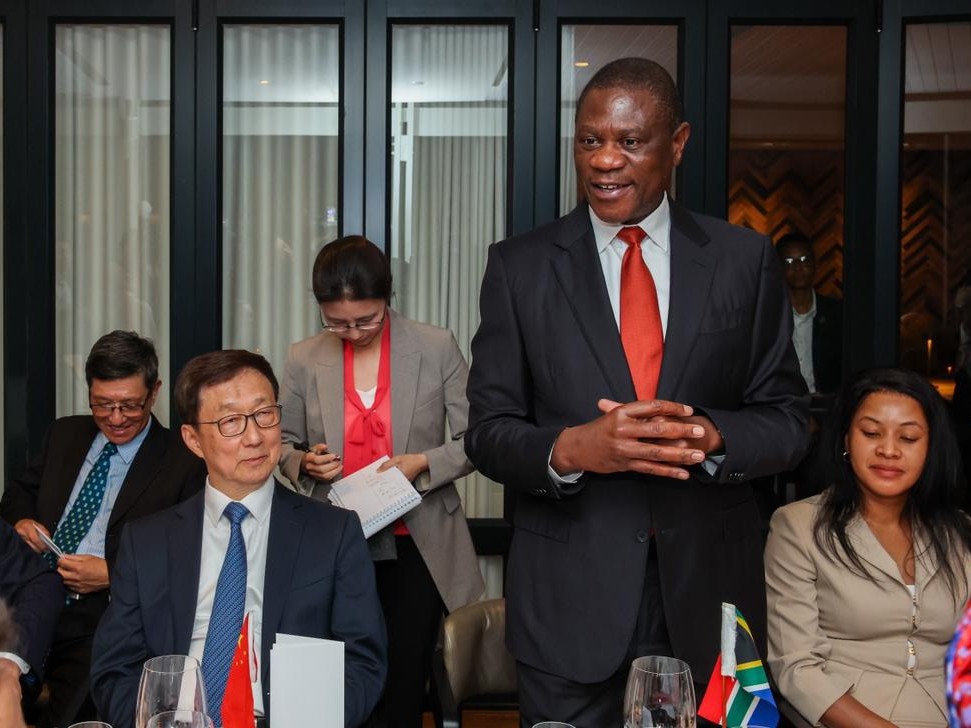
Cape Town -Deputy President Paul Mashatile says bilateral trade between South Africa and China has grown.
“Bilateral trade grew by 6.4%, rising from USD 34.2 billion in 2024 to USD 36.4 billion in 2025,” Deputy President Mashatile stated during his address on Friday, 27 March 2026, at the Economic and Trade Forum.
He said it was a privilege to address the forum, convened in the wake of the 9th Session of the Bi-National Commission, “which I had the honour of co-chairing yesterday” with visiting China Vice President Han Zheng.
Deputy President Mashatile said the conclusion of the Commission’s work marks a significant milestone in South Africa’s journey of a thousand miles with China.
“This is a journey that began with a single step in the year 2000, when our two nations agreed to establish the Bi-National Commission on the founding principle of equality, mutual respect, and shared progress,” said Deputy President Mashatile.
“Together, we have built bridges of trade and investment, strengthened the pillars of cooperation, and opened doors of opportunity for our peoples.
“We have also expanded sectoral collaboration in broad areas of tourism, mineral resources, environment, science & technology, education, and culture.”
He stated that economic cooperation remains central to government collaboration.
“Efforts are focused on restructuring trade to enhance value-added exports to China,” the deputy president said.
“This has positioned South Africa as China’s largest trade partner in Africa and its top global partner.”
As a result, bilateral trade grew.
He said the work that both governments have done has also paved the way for China to invest USD8.11 billion in 103 FDI projects, creating a total of 5 694 jobs in South Africa.
On the other hand, there is a group of South African companies that collectively invested USD689 million into China in the health, ICT, financial services, manufacturing, and services sectors.
“However, there is still much work to be done to diversify our exports from raw commodities and to strengthen South Africa’s industrial base in electric vehicle and battery manufacturing,” stated the deputy president.
“South Africa is keen to draw investments across various sectors, particularly in mineral beneficiation, the hydrogen economy & clean energy, ICT, textiles and leather.
“Over and above what we have achieved in our government deliberations, the signing of the Framework Agreement for the China Africa Economic Partnership Agreement (CAEPA) will cement South Africa’s status as an attractive sourcing destination.
“This agreement will effectively lower costs for Chinese companies importing South African goods while opening new avenues for our industries to expand their reach and competitiveness.
“In many ways, CAEPA is the natural outgrowth of the founding principle of our BNC.
He also referred to Deputy Minister of Trade, Industry and Competition, Alexandra Abrahams, who reported on the advancements regarding the Early Harvest Agreement aimed at ensuring that South African exports destined for China will receive permanent zero-tariff treatment, contingent upon consultations with domestic trade partners in the Customs Union.
“We also believe that the CAEPA solidifies South Africa’s status as a preferred destination for Chinese investment,” stated Deputy President Mashatile.
“Duty-free access for South African exports not only makes it more profitable for Chinese firms to source semi-processed and finished goods from South Africa, but it also makes the prospects of building local processing plants more viable.”
Dignitaries in attendance included Director General of CCPIT Lin Honghong, China Vice President Han Zheng, Deputy Minister Abrahams, Deputy Minister of International Relations Thandi Moraka, and Assistant Minister of the Ministry of Commerce of the China Council for the Promotion of International Trade Ren Hongbin.