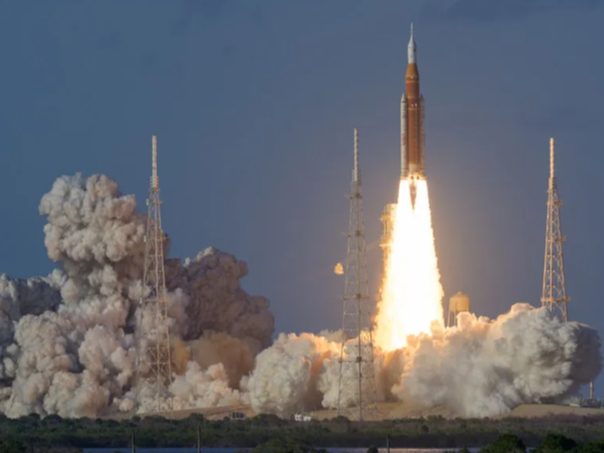
Cape Canaveral, Florida — At 6:35 p.m. EDT on April 1, 2026, the most powerful rocket ever built thundered off Launch Pad 39B at NASA’s Kennedy Space Center, painting the evening sky in a pillar of fire and smoke.
Aboard the Space Launch System (SLS) rocket rode four astronauts strapped into NASA’s Orion spacecraft: Commander Reid Wiseman, Pilot Victor Glover, Mission Specialist Christina Koch, and Canadian Space Agency astronaut Jeremy Hansen.
For the first time since Apollo 17 in 1972, humans were heading back toward the Moon.
The launch marked the beginning of Artemis II, a 10-day, 685,000-mile round-trip journey designed not for a landing but as the ultimate shakedown cruise for NASA’s deep-space hardware.
Over the next week and a half, the crew will fly a free-return trajectory — a figure-eight path around Earth and the Moon — reaching a lunar flyby around 6 April 2026 at roughly 6 000 miles from the surface before slingshotting home.
Splashdown in the Pacific off San Diego is targeted for around 10 or 11 April.
Along the way, they will travel farther from Earth than any humans since Apollo 13, testing systems that must work flawlessly before Artemis III attempts an actual lunar landing in 2028.
The mission’s primary goal is straightforward but critical: prove that Orion and SLS can safely carry humans through the rigors of deep space.
Engineers want to verify life-support systems, thermal control, radiation shielding, and the spacecraft’s heat shield, which must withstand re-entry speeds of nearly 25 000 mph (40 233.6 Km per Hour).
The crew will also practice emergency procedures, conduct a proximity-operations demonstration (simulating future docking maneuvers without actually docking), and gather data on how the human body copes with prolonged microgravity and cosmic radiation.
Success here clears the runway for sustained lunar presence — and, eventually, a crewed trip to Mars.
Yet for all its historic ambition, the mission’s most vivid drama unfolds inside a capsule barely bigger than a large shed.
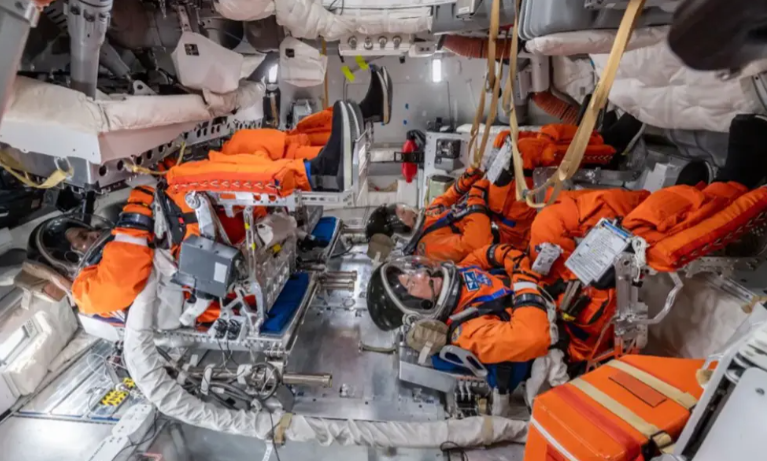
Orion’s crew module offers just 330 cubic feet of habitable volume — roughly the interior of two minivans — for four people over 10 days.
In zero gravity, every movement is a ballet of floating limbs and carefully tethered gear.
Daily life is a master class in cramped ingenuity.
The astronauts sleep in sleeping bags Velcroed to the walls, drifting off while tethered so they don’t bump into colleagues or equipment during the night.
Exercise comes via a compact resistive device that mimics weightlifting; without it, muscles and bones would atrophy alarmingly fast.
Meals are rehydrated pouches eaten with utensils clipped to trays to keep crumbs from becoming zero-g hazards.
Hygiene is equally Spartan: dry shampoo, wipes, and a compact “hygiene bay” tucked near the floor.
The bathroom — NASA’s new Universal Waste Management System — is the mission’s quiet luxury. Concealed in a floor panel, the suction-powered toilet handles both liquid and solid waste in microgravity.
A small door and privacy curtains provide what passes for solitude in a space the size of an airplane lavatory.
“We’re pretty fortunate as a crew to have a toilet with a door on this tiny spacecraft,” Hansen noted before launch.
Compared with Apollo crews who managed with plastic bags and adhesive, it’s a leap forward — yet still requires awkward contortions and precise technique to avoid messes that would float through the cabin.
Privacy is an illusion.
The crew must maintain through discipline and good humour.
Four strong personalities — Wiseman, a veteran test pilot; Glover, the first Black astronaut to fly beyond low Earth orbit; Koch, record-holder for longest single spaceflight by a woman; and Hansen, Canada’s first lunar traveler — share every cubic inch.
Stowage compartments double as radiation shelters during solar-particle events. Conversations, meals, and even quiet moments happen within arm’s reach of one another.
The faint hum of life-support fans and the occasional clink of floating tools become the soundtrack of their voyage.
As Artemis II hurtles toward the Moon, the world watches not just for the spectacle but for the quiet proof that humans can live and work far from Earth.
The cramped capsule, the suction toilet, the wall-strapped sleeping bags — these peculiar details are the real test.
If the crew returns healthy and the spacecraft performs, NASA will have taken the essential next step toward a permanent lunar presence and, one day, boots on Mars.
For now, four astronauts are writing the first chapter of humanity’s second Moon age — one careful, floating step at a time.
*Disclaimer: This article was compiled using AI tool Grok on X and may contain inaccuracies. Sources quoted include: nasa.gov, cnn.com, abcnews.com, nypost.com, wnct.com