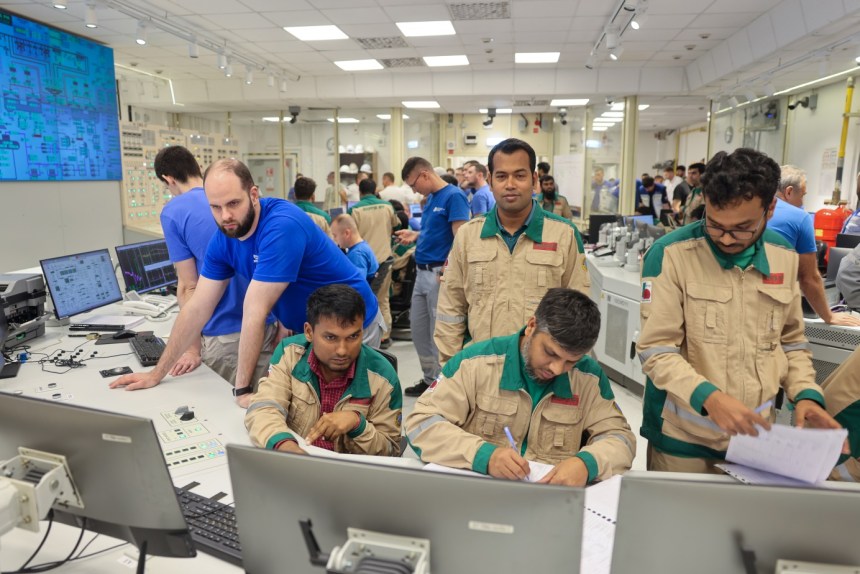
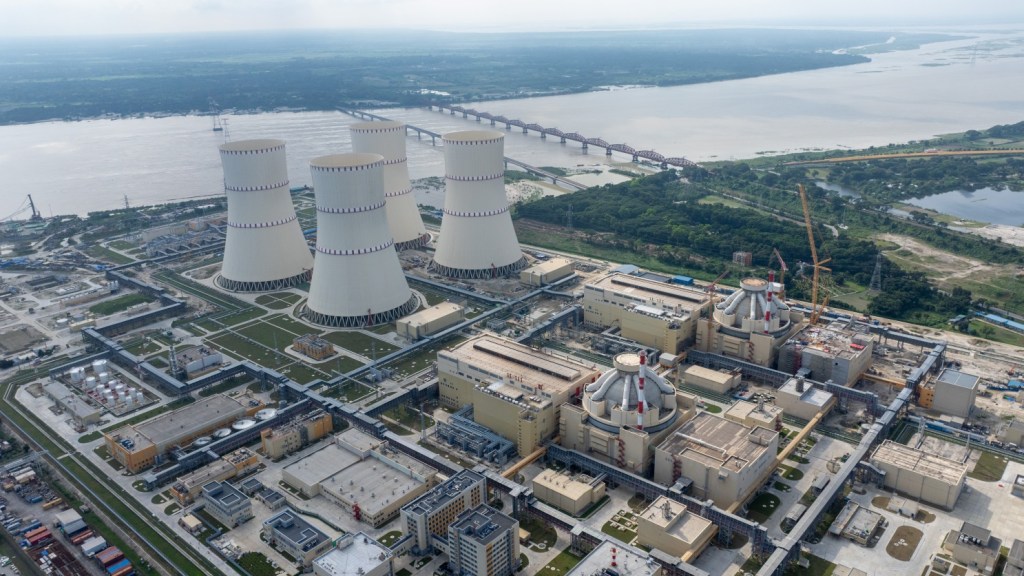
Rooppur – Unit 1 of Rooppur Nuclear Power Plant (NPP), the Rosatom project, has been synchronised with the national grid in Bangladesh.
The first megawatts generated at the plant reached the country’s power system.
The reactor reached 40% of its rated power – this is the point at which the generator can be connected to the grid for the first time.
The generator output stood at 370 MW.
“The power start-up of Unit 1 of Rooppur NPP is a landmark event for our two countries,” stated Rosatom Director General Alexey Likhachev.
“Bangladesh is gaining a reliable, stable, and environmentally friendly source of energy that will significantly reduce the country’s dependence on imported hydrocarbons.
“Nuclear power also provides Bangladesh with access to advanced technologies and contributes to the development of engineering expertise and scientific research.
“For Russia and Rosatom, the power start-up of Unit 1 of Rooppur NPP marks another successfully implemented project, demonstrating our country’s undisputed leadership in the global nuclear technology market.”
Africa’s first plant with the same technology is under construction in Egypt. El-Dabaa NPP is the continent’s first Generation III+ nuclear power plant.
All four of its units are being built at the same time, and around 26 000 people work at the site, most of them Egyptian nationals.
Reactor pressure vessels are already in place at Units 1 and 2.
Delivery of the first batch of fuel for Unit 1 is planned for 2027.
Turkey, another country building its first nuclear power plant with Rosatom, is also approaching start-up.
Unit 1 of Akkuyu NPP has started hot functional testing, the penultimate stage of tests before start-up operations.
All equipment of the reactor plant is being tested in operating modes before nuclear fuel is loaded for the first time.
As of June 2026, Rosatom is building 28 of the 32 power units under construction by nuclear vendors outside their home markets.
In October, Alexey Likhachev confirmed that Rosatom was ready to supply African countries with nuclear power plants of various sizes and configurations.
“Our partnership is based on the principle that Africa is diverse, and we have a tailored approach for each country that goes beyond a single project,” Likhachev said.