Cape Town – Former Nigerian Minister Kayode Fayemi said Africa must define its own priorities before responding to outside demand for its resources, arguing that India-Africa ties should become a strategic partnership with shared development goals.
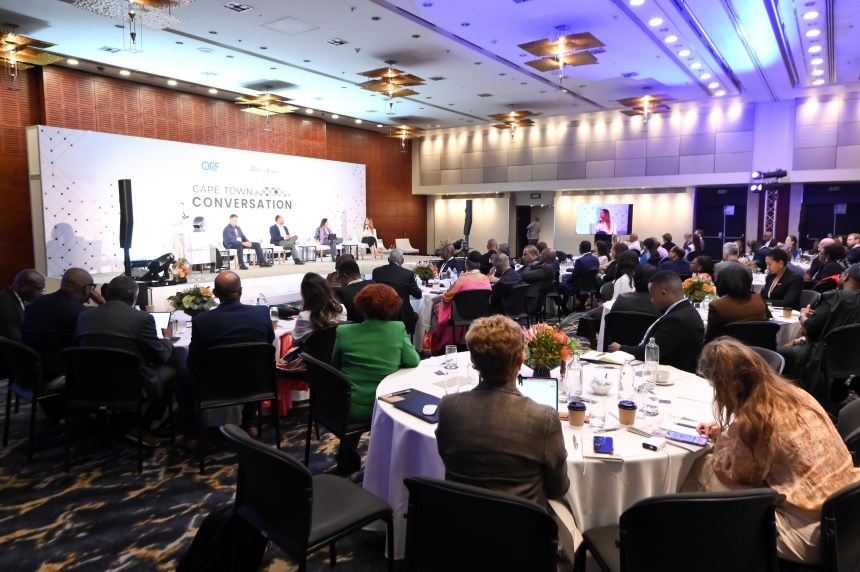
Fayemi made the remarks on 24 November 2026 during an Africa-India discussion at the fourth Cape Town Conversation, co-hosted by the Thabo Mbeki Foundation and India’s Observer Research Foundation at The Westin Cape Town.
Held under the theme “Shaping Shared Futures in a Transforming World”, the event examined how cooperation could become more consequential in an increasingly divided global order.
Fayemi, the former Nigerian minister of solid minerals development, said the relationship between India and Africa had deep historical roots but remained too transactional.
“It needs to move from historical solidarity and emotional connection to strategic partnership,” he said.
Together, India and Africa represented about three billion people, or roughly a third of the world’s population, he said.
Their partnership and influence over global institutions, however, remained below what that combined scale could command.
That gap, Fayemi argued, could not be closed through trade alone. Cooperation needed to include digital public infrastructure, security and climate action, as well as manufacturing and value addition.
He urged governments to build a longer-term relationship that could strengthen both regions’ influence over global rules.
His challenge on minerals was part of a wider argument about who sets Africa’s priorities.
“Critical to who?” he asked, warning that outside countries’ demand for minerals should not determine what African governments consider essential.
He argued that industrial minerals and the infrastructure needed for development could matter more to African countries than minerals sought for batteries or energy technologies.
Fayemi said African governments needed to agree on their own agenda and use continental institutions to advance it.
The African Union’s African Mining Vision, he said, already set out priorities including beneficiation, value addition, environmental protection and infrastructure.
The challenge was to implement such plans. He also questioned whether India’s engagement was delivering the development outcomes African leaders wanted.
India, he said, had historical and geographic ties with Africa, but some leaders viewed its relationship with the continent as less developmental and more transactional than China’s.
At the same time, Fayemi said African countries could learn from India’s strategic autonomy: its ability to engage with competing powers while pursuing its own national interests.
His point was not to choose between India, China, the United States or Gulf states, but to clarify what Africa wanted from each partnership.
The panel’s other speakers focused on the practical conditions needed to turn that ambition into economic cooperation.
Herbert Krapa, former energy minister of Ghana, argued for policy coordination, regional production hubs and investment terms that would create jobs, build skills and transfer technology.
Countries, he said, should “complement rather than compete” when developing regional industries.
Dammu Ravi, India’s former secretary for economic relations in the Ministry of External Affairs, said the relationship needed to extend beyond diplomatic goodwill.
Without stronger economic links, he said, political ties risked becoming “statements” and “big slogans”.
He called for India and African countries to develop supply chains and manufacturing capacity, with projects tailored to local conditions.
The debate echoed concerns raised in other sessions on the forum’s opening day. Nelson Muffuh, the United Nations resident coordinator in South Africa, said that having more partners did not necessarily give African countries greater agency if the underlying terms of their economic relationships stayed the same.
He argued that African countries needed stronger institutions, skills, infrastructure and access to capital to turn new interest in the continent into jobs and improved livelihoods.
In a session on the geoeconomic order, Anand Sharma, India’s former minister of commerce and industry, linked the changing balance of power to shortcomings in global governance.
He criticised the absence of permanent African representation on the United Nations Security Council and noted that India, which he described as the world’s largest democracy, also had no permanent seat.
Sharma argued that reform was needed to make the body more representative of current global realities.
Lina Khatib, director of global policy and systemic risks at the Security Futures Lab at the University of Oxford’s Oxford Martin School, said economic resilience depended on more than infrastructure and finance.
Countries also needed a role in setting international standards.
“Who is taking part in writing the rules?” she asked.
That question carried into a session on artificial intelligence.
Sameer Chauhan, director of the United Nations International Computing Centre, said countries needed the skills, institutions and data to develop artificial intelligence in line with their own priorities.
The aim, he said, should be to build systems that a country “can own and maintain”, rather than leave it locked into a vendor’s technology.
The forum’s development-finance plenary addressed another obstacle: turning commitments and funding into projects that can be built.
Naveen Srivastav, former ambassador of India to Nepal and director general and corporate secretary of the New Development Bank, said countries needed to set their own development priorities, prepare viable projects and combine domestic resources with bilateral and multilateral finance.
Those discussions gave Fayemi’s call for a strategic Africa-India partnership a practical test.
Shared history and diplomatic ties, speakers suggested, would matter less if they did not lead to investment in local industries, skills, energy, technology and regional markets.
For Fayemi, the starting point was African leadership and a clear collective agenda.
“What is Africa’s interest?
That’s what we need to do,” he said.
His question was whether the continent could define that interest and organise its partnerships around it, rather than let competition among external powers set the terms.