Pretoria – A judge is going to be appointed to reopen the inquest into the deaths of four anti-apartheid activists, who became known as the “Cradock Four”, the Department of Justice and Correctional Services announced Friday.
In a statement, the department said: “The Minister of Justice and Correctional Services has acted on a recommendation of the National Prosecuting Authority to approach the Judge President, Eastern Cape Division, Gqeberha, in terms of section 17A (1) of the Inquests Act 58 of 1959, to appoint a judge to reopen and direct the reopened inquest into the deaths of Mr. Mathew Goniwe (Goniwe), Mr. Sparrow Mkonto (Mkonto), Mr. Fort Calata (Calata) and Mr. Sicelo Mhlauli (Mhlauli)”.
The move was done under Section 17A of the Inquests Act, No. 58 of 1959, which states that the Minister may, on the recommendation of the Attorney-General (National Director Public Prosecutions) concerned, at any time after the conclusion of an enquiry and if he (she) considers it necessary in the interests of justice, request a Judge President of a Provincial Division of the High Court to nominate any Judge of the High Court of South Africa to reopen the enquiry, whereupon the Judge so nominated shall reopen the enquiry.
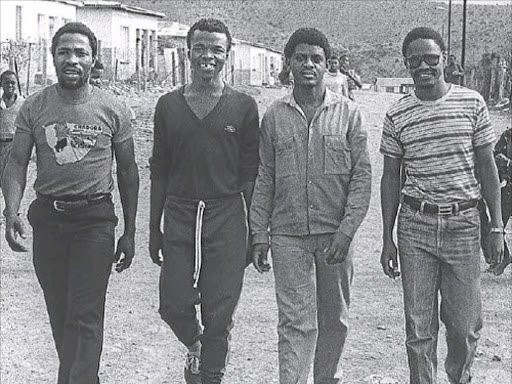
On 27 June 1985, Goniwe, Calata, Mkonto, and Mhlauli left Port Elizabeth after attending a meeting.
They were on their way home to Cradock.
They never arrived.
The only people to see them alive were their killers, whose identity and motive remained unknown until the Truth and Reconciliation Commission (TRC) was established in 1996.
They were then abducted and murdered. Days later, their badly burnt bodies, with numerous stab wounds, were discovered in two different places.
They became known as the “Cradock Four”.
All four anti-apartheid activists had attracted the attention of the Security Branch (SB) and the government of the day on numerous occasions.
Who were the Cradock Four?
Goniwe, an educator who was also a rural organiser of the United Democratic Front (UDF) and a community leader, was instrumental in the formation of the Cradock Residents Association (CRADORA) and the Cradock Youth Association (CRADOYA).
He was also very active in the anti-apartheid movement during the Soweto uprisings in 1976.
Calata was also a pedagogue and a close political ally of Goniwe.
He was arrested after writing a letter to the town council informing them of the filthy streets and unsanitary bucket system. After his transfer to Cradock, he was also an active member of the UDF and worked alongside Goniwe.
Mhlauli was a close childhood friend of Goniwe.
He was the headmaster of a secondary school in Oudtshoorn, a community leader, and an active member of the UDF. He too had been constantly harassed by the security police.
Mkonto was a railway worker who was instrumental in the formation of CRADOYA and CRADORA.
He was the highest-ranking officer of CRADORA.
New Evidence Into The Deaths Of Goniwe, Calata, Mkonto and Mhlauli
The department said an inquiry must be so thorough that the public and the parties concerned are satisfied that the circumstances of the death “have been fully and fairly investigated”.
Two inquests were held.
Both the De Beer inquest in 1987 and the Zietsman inquest in 1993 produced more questions than answers. Neither of the inquests identified the murderers of the deceased.
Evidence At The TRC
The narrative that the identity of the murderer(s) of the deceased was unknown, or why and how they died, would have remained a well-kept secret if the SB members had not appeared before the TRC and revealed how and why the deceased were killed, 14 years after the gruesome deaths of the deceased.
In this context, the TRC stated: “The Commission finds that in the late 1980s the SAP, and particularly its SB, embarked on a programme of assassinations of political activists.
“The evidence before the Commission indicates that the resulting deaths and disappearances of activists were part of a systematic pattern of abuse involving premeditated planning by members of the SAP, for which the SAP and the South African government are held responsible.”
The new evidence, which has never before been presented to a court of inquiry, consists primarily of the amnesty applications of six security police officers Harold Snyman (Snyman), Eric Alexandra Taylor (Taylor), Gerhardus Johannes Lotz (Lotz), Nicolaas Janse van Rensburg (van Rensburg), Johan van Zyl (van Zyl) and Hermanus Barend du Plessis (du Plessis), who were asked during the TRC amnesty hearings. Eugene de Kock (de Kock) was pardoned for his role in the murders.
The Interest of Justice And The Rationale For the Re-opening
In Azanian People’s Organisation and Others v President of the Republic of South Africa CCT 17/96 of 25 July 1996, Justice Mohamed (then Deputy President of the Constitutional Court) quoted Justice Marvin Frankel who in his book Out of the Shadows of the Night: The Struggle for International Human Rights, wrote: “A nation divided during a repressive regime does not emerge suddenly united when the time of repression has passed.
“The human rights criminals are fellow citizens living alongside everyone else, and they may be very powerful and dangerous.
“If the army and police have been the agencies of terror, the soldiers and the cops aren’t going to turn overnight into the paragons of respect for human rights.”
The TRC Final Report (Volume One, Chapter One, Page 7) commented: “However painful the experience, the wounds of the past must not be allowed to fester. They must be opened.
“They must be cleansed. And balm must be poured on them so that they can be healed.
“This is not to be obsessed with the past. It is to take care that the past is properly dealt with for the sake of the future. “
The department said the main reason for reopening the investigation was that it was in the interests of justice to do so.
“The National Prosecuting Authority Service firmly believes that the evidence that became available after the De Beer and Zietsman investigations constitute new evidence that was not previously presented before a new order was issued,” the department said.
The department said there were numerous inconsistencies between the first and second investigations and new evidence after the findings that warrant a retrial.
“Minister Lamola believes that it is in the interests of justice to finally bring closure to the families of the deceased who have been waiting decades for the truth about who killed their loved ones,” the department said.
“The family of the Cradock four now want to finally clarify how the deceased came to their deaths.
“They have spoken out strongly in favour of reopening the investigation.”
Commenting on the matter, Minister Lamola said: “The privilege of presenting evidence in a democratic South Africa must be exercised.
“In the previous inquests, the voices of the families and those affected have not been heard.
“It is time for confidence in the justice system to be restored.”