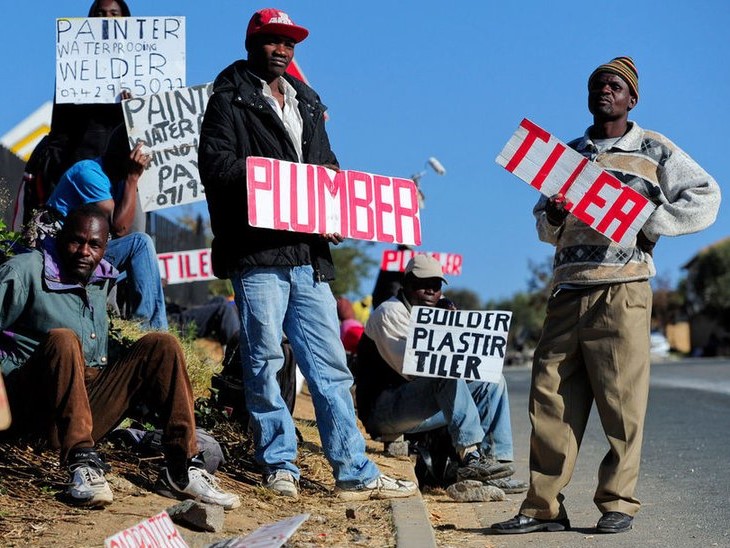
Johannesburg – The number of jobless people – mostly young persons and women – increased in the fourth quarter of 2023, Statistics South Africa said Tuesday.
“The results of the QLFS indicate that the number of employed persons decreased by 22 000 to 16,7 million in the fourth quarter of 2023 compared to the third quarter of 2023,” said Statistics South Africa in a statement.
“The number of unemployed persons increased by 46 000 to 7,9 million during the same quarter.”
Additionally, the number of people who were not economically active for reasons other than discouragement increased by 218 000 to 13,4 million, while discouraged work seekers decreased by 107 000 in the fourth quarter of 2023 compared to the third quarter of 2023.
Statistics South Africa said this resulted in a net increase of 111 000 in the not economically active population.
The changes in employment and unemployment resulted in the official unemployment rate increasing by 0,2 of a percentage point from 31,9% in the third quarter of 2023 to 32,1% in the fourth quarter of 2023.
The unemployment rate according to the expanded definition decreased by 0,1 of a percentage point to 41,1% in Q4: 2023 compared to Q3: 2023.
“Formal sector employment decreased by 128 000 in Q4: 2023, while informal sector employment increased by 124 000 over the same period,” the statement said.
Industries that contributed to the net employment decline include community and social services (down by 171 000), construction (down by 36 000), agriculture (down by 35 000), trade (down by 28 000), and manufacturing (down by 1 000).
However, the statement said there were more people employed in finance (up by 128 000), transport (up by 57 000), mining (up by 37 000), and private households (up by 18 000).
These sectors recorded the largest employment gains.
Provincially, employment losses were recorded in the Eastern Cape (111 000), Limpopo (40 000), North West (30 000) and Northern Cape (2 000).
The largest employment increase was recorded in KwaZulu-Natal (62 000), followed by Mpumalanga (48 000) and Western Cape (23 000) during the same period.
The youth (15–34 years) remain vulnerable in the labour market; the fourth quarter of 2023 results show that the total number of unemployed youth increased by 87 000 to 4,7 million while there was a decrease of 97 000 in the number of employed youth to 5,9 million.
This resulted in an increase in the youth unemployment rate by 0,9 of a percentage point from 43,4% in Q3: 2023 to 44,3% in Q4: 2023.
Commenting on the matter, Casey Sprake, Investment Analyst, Anchor Capital, said: “South Africa faces a significant unemployment problem that continues to pose challenges for the country’s economic and social development.
“The unemployment rate has remained stubbornly high for many years, with a complex range of factors contributing to the issue.”
Sprake said a combination of structural deficiencies, such as a lack of skills, limited access to quality education and training, and inadequate job creation, has resulted in a large portion of the population being unable to find gainful employment.