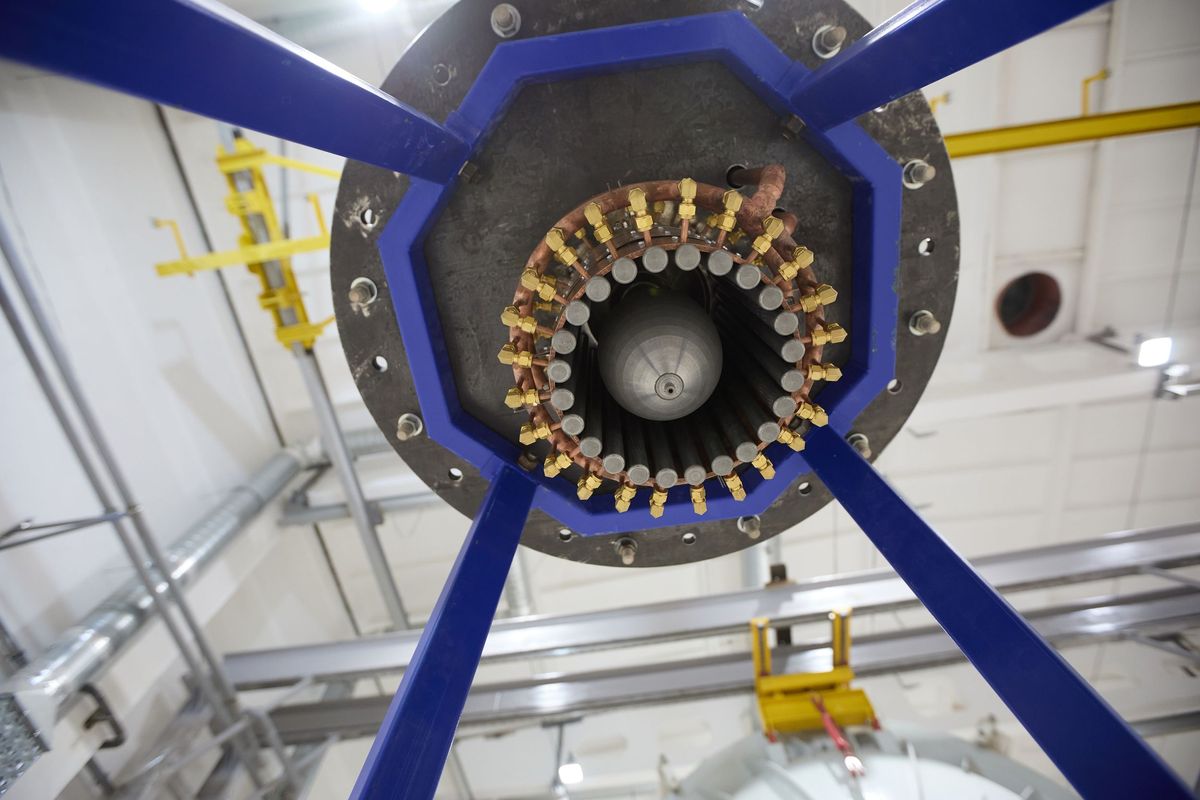
Moscow – Russia’s Rosatom has developed a plasma electric rocket engine that could cut down space travel time to Mars to between 30 to 60 days.
“At present, a one-way travel to Mars onboard spacecraft with conventional engines can take almost a year,” said Alexey Voronov, First Deputy Director General for Science at Rosatom’s Research Institute in Troitsk.
“Plasma engines could reduce the duration of flights to just 30 to 60 days, making return missions to Mars possible.”
Scientists at Rosatom have developed a laboratory prototype of a plasma electric rocket engine based on a magnetic plasma accelerator.
This innovation enables spacecraft to achieve higher speeds than chemical engines while reducing fuel consumption tenfold.
The plasma electric rocket engine demonstrates enhanced thrust performance (at least 6 Newtons) and specific impulse (at least 100 kilometres per second).
The project to develop the plasma electric rocket engine was part of a comprehensive programme focused on advancing nuclear science, engineering, and technology in Russia.
The programme was launched under the national initiative for technological leadership “New Nuclear and Energy Technologies” in 2025.
“Operating in a pulsed-periodic mode, this engine can reach 300 kilowatts,” Rosatom explained in a statement made available to The Bulrushes on Wednesday, (12 February 2025).
“It enables spacecraft to reach speeds beyond the capabilities of chemical engines, while also improving fuel efficiency by reducing fuel consumption tenfold.
“A large-scale experimental facility was under construction at the Troitsk site to test the plasma rocket engine prototype and other similar technologies.”
The facility’s main equipment, the vacuum chamber, has a diameter of 4 metres and a length of 14 metres, the statement said.
“The chamber was planned to be equipped with advanced systems for high-efficiency vacuum pumping and heat removal,” said Rosatom.
These systems make it possible to create space-like conditions.
“The creation of a prototype is a crucial milestone in the project as it shows whether the engine is suitable for future ‘nuclear tugs’ in space and whether it is possible to reduce the cost of their production,” said Voronov.