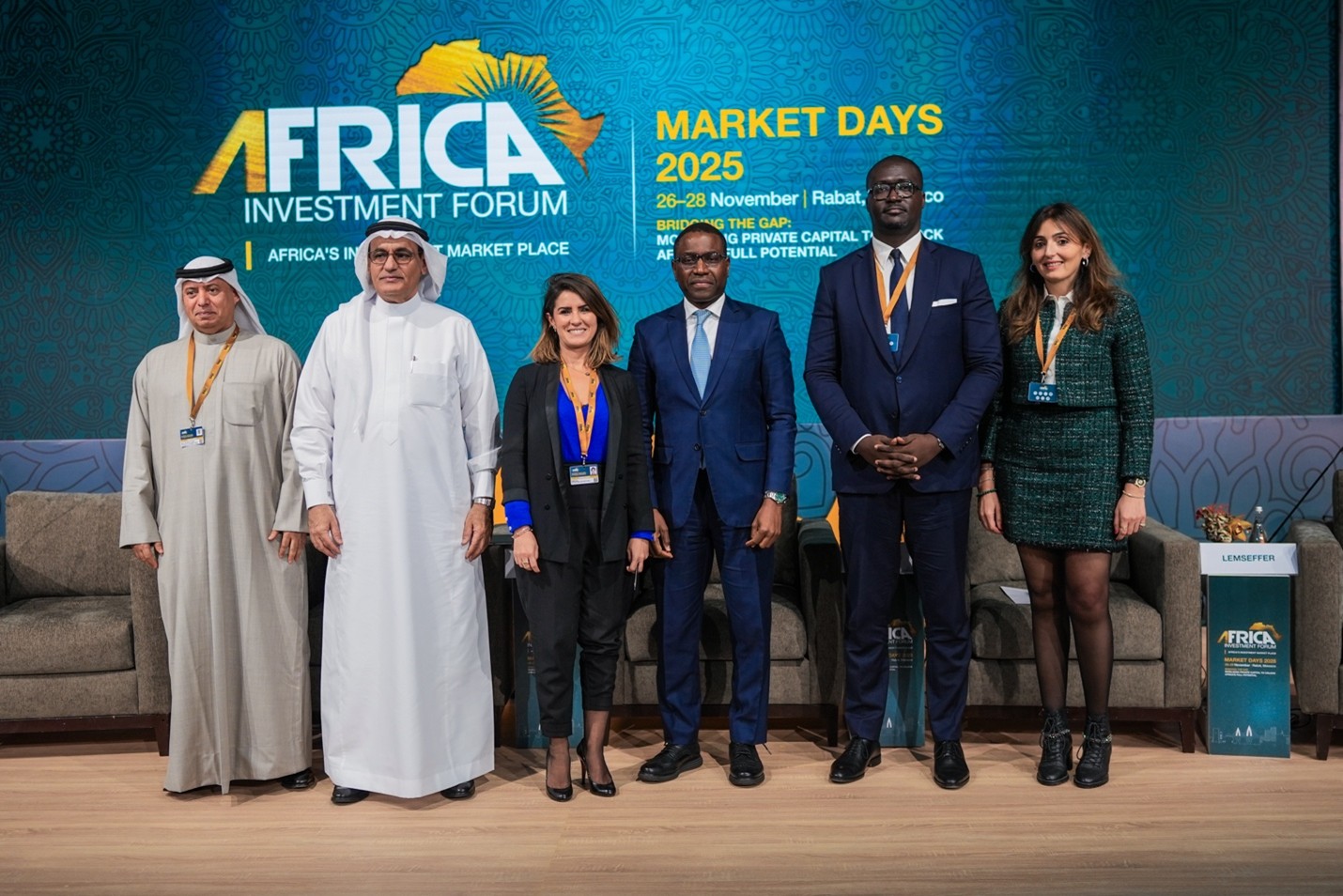
Rabat – Senior policymakers, investors, and development finance leaders converged at the 2025 Africa Investment Forum Market Days to tackle one of the continent’s most pressing challenges: unlocking the capital required to meet surging infrastructure and climate demands.
The high-level panel, titled “Innovative Finance Instruments Powering Africa’s Sustainable Transformation,” served as a clear call to action for adopting new approaches beyond conventional funding models and into a new era of investment.
Moderated by Boston Consulting Group’s Partner and Managing Director, Zineb Sqalli, the session opened on Thursday, 27 November 2025, with a stark assessment: By 2050, Africa will add one billion people, more than half in cities, yet it invests only $75 billion of the $150 billion it needs annually for infrastructure.
The climate-finance gap is even wider, with the continent receiving just $30 billion of the $300 billion required each year.
“This gap is massive, but it is also a great opportunity,” Sqalli said, highlighting the growth of blended finance, Islamic green bonds, diaspora vehicles, and new infrastructure platforms.
Setting a determined tone, Dr. Obaid Saif Hamad Al-Zaabi, Chairman of the Arab Authority for Agricultural Investment and Development, called for a fundamental shift in how food systems are financed.
With climate pressures and food insecurity rising across Africa and the Arab world, he called for treating the food-security value chain as a strategic asset class.
“Climate change is no longer an environmental issue – it is a financial risk on our balance sheets,” he warned.
Al-Zaabi advocated for expanded guarantees, sustainable finance instruments, and specialised vehicles for smallholder farmers, whom he called the “engine” of Africa’s food system.
He added that digitalisation was vital to reducing information asymmetry and building investor trust.
On broader investment readiness, Amadou Hott, Chairman of the Africa Advisory Board of Vision Invest and former Senegalese Minister of Economy, said the continent’s most severe bottleneck remains the scarcity of bankable projects.
“If we want to transform the continent, we need to multiply what we are doing today by 100 or even 150,” he said.
Hott stressed the need for far stronger project-preparation capacity and pointed to currency risk as a major deterrent.
He urged African governments to mobilise more domestic capital – from sovereign wealth funds, pension assets and reserves – much of which is currently invested offshore.
Dr. Nasser Al-Kahtani, Executive Director of the Arab Gulf Programme for Development, emphasised that Africa cannot meet its development targets without deepening inclusive finance.
“Seventy percent of the food we eat comes from small farmers. They save the world, but cannot feed themselves,” Al-Kahtani said, urging blended-finance structures that shift countries “from grants to investment” while building equity for micro-entrepreneurs.
A private sector perspective on financing Africa’s infrastructure gap was presented by Jacques Kanga, Director and Head of Finance at Algest Investment Bank.
Kanga outlined how targeted financial instruments could be the key to mobilising private capital and closing the continent’s estimated annual $130 billion to $170 billion funding shortfall.
He identified infrastructure Special Purpose Vehicles that reduce sovereign and political risk, blended-finance structures that lower project costs, and diaspora-backed financing that taps into the $95 billion Africans abroad send home each year.
According to Kanga, these tools reinforce transparency, governance, and global investor confidence.
Ouns Lemseffer, Partner at Ashurst, highlighted progress across the continent, with several countries adopting advanced securitisation and sustainable-finance laws that enable project bonds, Sukuk, debt funds, and innovative financing for electrification initiatives such as Côte d’Ivoire’s Programme Électricité Pour Tous.
But she cautioned that progress remains uneven.
“A sophisticated legal framework in one area is not enough,” Lemseffer said.
“Policymakers need a holistic approach – from investor rules to bankruptcy protection – to fully open capital markets to long-term infrastructure investment.”
As the session closed, the message from the high-level panel was definitive. Innovative finance is indispensable for Africa’s future.
Panelists converged on a unified vision where new financial instruments are central to mobilising the scale of capital required to meet the continent’s immense demographic, climate, and economic ambitions, effectively converting opportunities into transformative, investable projects across Africa.