Johannesburg – Rand Water is owed R3 billion by municipalities, mostly in Gauteng, and the bulk potable water supplier has warned it was going to reduce the flow to offenders to compel settlement of debts.
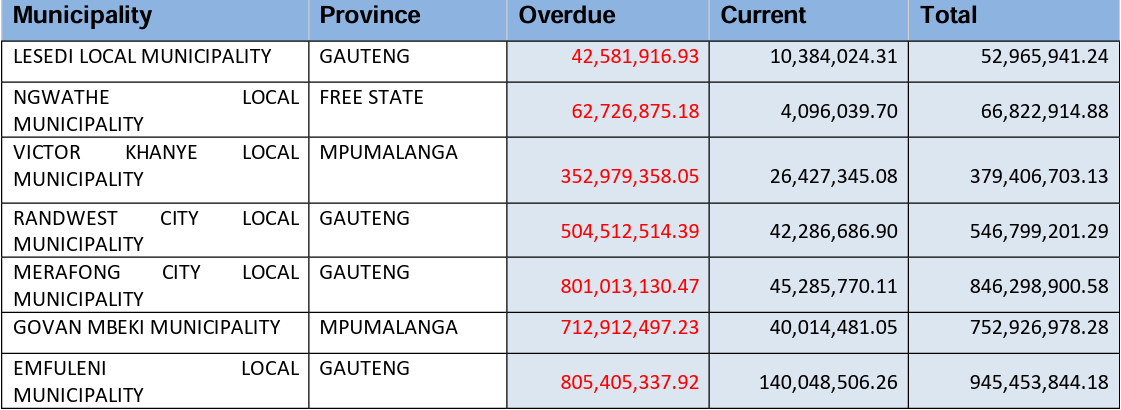
“To date, municipalities owe Rand Water a cumulative overdue amount of R3 billion, with R2 billion relating to Gauteng municipalities, R1 billion from Mpumalanga municipalities, and at least R63 million from Free State municipalities,” the bulk potable water supplier said in a statement on Friday.
“Rand Water is deeply concerned over the escalating debts caused by municipalities’ failure to honour their bulk water purchase agreements and debt settlement arrangements.
“This situation highly destabilises Rand Water’s financial position and poses a direct threat to its medium and long-term sustainability.”
Rand Water said it operates without any form of allocation from the national fiscus and thus relies solely on funds collected from its customers, primarily municipalities to fulfil its obligations.
Rand Water said the following non-performing municipalities were contributing to the long-overdue debt:
“The payment patterns of municipalities have deteriorated to concerning levels that threaten the liquidity, financial performance, and sustainability of Rand Water,” said the statement.
“Despite our relentless efforts to accommodate this ongoing pattern of non-payment through bilateral engagements and participation in Intergovernmental Relations forums, we have regrettably reached a stalemate.”
Rand Water said several agreements and engagements were held with non-paying municipalities.
However, Rand Water said it was “evident that these municipalities have taken advantage of these avenues and use them to cause endless and fruitless negotiations when it is clear that they have no intention to pay or enter into amicable arrangements that will afford them an opportunity to pay their account with ease”.
Rand Water said some of these municipal customers were taking an inordinately long time to sign the agreements.
“The magnitude of the outstanding debt from municipalities has reached a critical level, thus requires urgent attention,” the water utility warned.
Rand Water said in that regard it has invoked the provisions of Section 41(1) of IRFA and has declared an intergovernmental financial dispute.
The bulk potable water supplier said it will seek intervention from the National Treasury and Co-operative Governance and Traditional Affairs.
In terms of the Promotion of Administrative Justice Act 3 of 2000, Rand Water warned residents and communities of the defaulting municipalities of its intention to exercise its right to invoke the provisions of Section 4 of the Water Services Act, to initiate curtailment of water flow due to non-payment of services.
“Rand Water therefore advises the communities of Ngwathe Local Municipality and Merafong City Local Municipality that on the 26th of February 2024 it reduced the water flow by 20%,” the statement revealed.
“Should these municipalities fail to pay the overdue amount or enter into an amicable payment arrangement, Rand Water will further implement another 20% on the 25th of March 2024.”
Rand Water said it was also in the process of employing the same credit control measures to compel other municipalities that were failing to honour their Debt Settlement Agreements.
“It is important to note that should Rand Water be placed under further ongoing financial risk, the entity will be plunged into a debt crisis, which will impact all municipalities currently serviced by Rand Water,” said the statement
Such debts could curtail the ability of Rand Water to finance the construction and augmentation of bulk water infrastructure and its ability to undertake adequate maintenance of its extensive network.
“This would have dire consequences on the entire network, particularly Gauteng Province and other parts of the country that are serviced by Rand Water,” the statement warned.
While the water utility said it remains committed to serving its customers and ensuring the long-term security of the supply of potable bulk water, it implored the owing municipal customers to “treat this matter with the utmost urgency”.