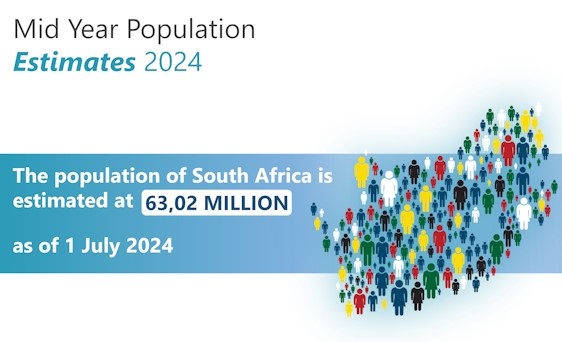
Johannesburg – South Africa’s population has grown to an estimated 63,02 million in 2024, according to a report released Tuesday by Statistics South Africa (Stats SA).
The female population accounts for 51,0% (approximately 32,13 million).
South Africa’s population grew by 19,8 percentage points between 2011 and 2022, from 51,7 million persons in 2011 to 62 million persons in 2022
Gauteng continues to record the largest share of the South African population, with approximately 15,83 million people (25,1%) living in this province.
KwaZulu-Natal is the province with the second largest population, with an estimated 12,34 million people (19,6%) living in this province.
With a population of approximately 1,36 million people (2,2%), the Northern Cape remains the province with the smallest share of the South African population.
According to the report, 27,5% of the population is aged younger than 15 years (16,8 million) and approximately 9,7% (6,13 million) is 60 years or older.
The provinces reflecting the highest percentage of children younger than 15 within its structure are Limpopo (33,2%) and EC (31,8%).
“The proportion of elderly persons aged 60 years and older in South Africa is increasing over time and as such policies and programmes to care for the needs of this growing population should be prioritised,” Stats SA cautioned.
The report further shows that life expectancy at birth for 2024 is estimated at 63,6 years for males and 69,2 years for females.
The infant mortality rate for 2024 is estimated at 22,9 per 1 000 live births.
According to the report, the estimated overall HIV prevalence rate is approximately 12,7% among the South African population.
The total number of people living with HIV (PLWHIV) is estimated at approximately 8,0 million in 2024.
For adults aged 15–49 years, an estimated 16,7% of the population is HIV positive.
“For the period 2021–2026, Gauteng and Western Cape are estimated to experience the largest inflow of migrants of approximately, 1 401 895 and 491 296 respectively,” Stats SA said.
“There is a reduction in international migration, which is indicative of the Covid-19 travel restrictions and subsequent impact on migratory patterns since March 2020.
“Migration is an important demographic process, as it shapes the age structure and distribution of the national and provincial population.”
For more detailed information download the full report here.