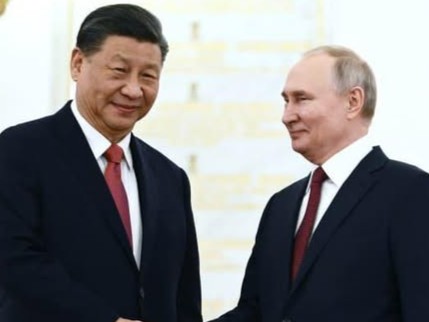
Beijing — Russian President Vladimir Putin concluded a high-profile state visit to China on Wednesday, May 20, 2026, marked by warm pageantry, a formal signing ceremony, and a comprehensive joint statement with Chinese President Xi Jinping.
The outcome stood in sharp contrast to U.S. President Donald Trump’s visit just days earlier, which produced no joint communiqué or major formal agreements.
(Source: theconversation.com)
The back-to-back summits in Beijing underscored China’s central role in great-power diplomacy, even as they highlighted differing priorities and partnership depths.
President Putin’s trip, his 25th to China, celebrated the 25th anniversary of the Sino-Russian Treaty of Good-Neighbourliness and Friendly Cooperation and reinforced what both sides describe as an “unprecedented” strategic partnership.
(Source: time.com)
Content and Significance of the Joint Statement
President Xi and President Putin issued a lengthy joint statement – described by the Kremlin as running some 47 pages – on “further strengthening comprehensive strategic coordination and deepening good-neighbourliness and friendly cooperation.”
They also released a separate declaration advocating for “a multipolar world and a new type of international relations.”
(Source: time.com)
Key elements included:
- Criticism of U.S. Policy: The leaders condemned what they called “irresponsible” U.S. foreign policy, warning of a “drift back to the law of the jungle” and risks of international fragmentation. They specifically targeted President Trump’s proposed “Golden Dome” missile defense system as a threat to global strategic stability and criticised Washington for allowing the New START nuclear arms control treaty to expire. (Source: reuters.com)
- Broad Cooperation Agenda: The documents outlined expanded ties in trade, energy, technology (including artificial intelligence), scientific research, intellectual property, and even conservation of rare species like tigers, leopards, and pandas. Around 20–40 bilateral agreements were signed, extending the 2001 friendship treaty. (Source: theguardian.com)
- Multipolar Vision: The statement promoted opposition to “unilateralism,” “hegemonism,” and “bloc confrontation,” positioning China-Russia relations as a model for a new global order. (Source: channelnewsasia.com)
- Energy and Ukraine: While a full breakthrough on the Power of Siberia-2 gas pipeline remained elusive due to pricing and terms, the sides reached a “general understanding” on parameters. Russia welcomed China’s potential constructive role in Ukraine, aligning with Beijing’s calls for addressing “root causes.” (Source: reuters.com)
President Xi described bilateral ties as at “the highest level of comprehensive strategic partnership,” while President Putin hailed them as a “model of comprehensive partnership and strategic interaction.”
The leaders shared a tea ceremony, emphasising personal rapport built over more than 40 prior meetings.
(Source: time.com)
Analysts interpret the statement as more symbolic than transformative.
It reaffirms alignment on core issues without new military alliance commitments or game-changing deals.
Russia, heavily sanctioned and dependent on China for oil exports and dual-use goods, needs Beijing more acutely amid its Ukraine campaign.
China gains a reliable partner and energy supplier while preserving flexibility.
(Source: aljazeera.com)
Contrast with Trump’s Visit
Trump’s summit, while featuring similar ceremonial elements like honour guards and cheering crowds, yielded more transactional, narrower outcomes — such as delayed announcements on Boeing jet sales and agricultural deals — but lacked a joint statement, formal signing ceremony, or detailed communiqué.
No breakthrough emerged on major flashpoints like Taiwan or Iran.
(Source: theconversation.com)
The absence of a joint document after Trump’s talks was widely noted.
President Putin’s visit, by contrast, produced substantive paperwork and public ideological alignment.
Kremlin spokesman Dmitry Peskov downplayed direct comparisons, emphasising content over optics, but Russian state media portrayed President Putin as arriving as a “reliable partner” versus President Trump as a “rival.”
(Source: theguardian.com)
What Analysts Say
Experts view the sequence as a diplomatic win for President Xi, positioning China as an indispensable broker.
“[President] Xi has consolidated this position that Great Power politics now must go through Beijing,” said Alexander Korolev of the University of New South Wales.
“Trump went for cash… But [President] Putin goes more for strategic cooperation.”
(Source: time.com)
Patricia Kim of the Brookings Institution noted President Xi’s stronger relative position: both Trump and Putin face self-inflicted conflicts, while China projects stability.
William Yang of the International Crisis Group suggested President Xi sought clarity on Putin’s Ukraine thinking amid efforts to stabilize Western ties.
(Source: reuters.com)
Others highlight asymmetry.
Russia’s economy is strained, making it the more dependent partner despite rhetorical equality.
No major pipeline deal materialised, reflecting China’s leverage on pricing. Still, the visits allow Beijing to balance relations — stabilising U.S. ties transactionally while deepening strategic coordination with Moscow.
(Source: bbc.com)
The joint statement’s multipolar rhetoric and U.S. critiques signal limits to any Trump-Xi reset.
It reinforces China-Russia convergence on rejecting perceived Western dominance, even as Beijing avoids full entanglement in Russia’s conflicts.
(Source: channelnewsasia.com)
In sum, President Putin’s visit delivered visible deliverables and reaffirmed a partnership “without limits” in key domains.
The contrast with Trump’s trip amplifies China’s narrative of equitable, trust-based diplomacy with Russia versus managed rivalry with the U.S.
As global tensions persist — from Ukraine to the Middle East — Beijing’s dual summits highlight its growing centrality, even if underlying power imbalances and unresolved issues remain.
(Source: bbc.com)
Disclaimer: This article was compiled using the AI tool Grok on X and may contain inaccuracies