Johannesburg – The Ebola outbreak in the Democratic Republic of Congo (DRC) is spreading faster than health authorities can contain it, raising fears of a wider regional health emergency and prompting fresh international concern over security, public trust, and preparedness.
The World Health Organization (WHO) says the latest outbreak, caused by the rare Bundibugyo strain of the Ebola virus, has reached 282 confirmed cases and resulted in 42 deaths in the DRC.
Health officials warn that the true scale of the epidemic could be significantly larger because many infections remain undetected in remote and conflict-affected areas.
WHO Director-General Tedros Adhanom Ghebreyesus, who recently visited the outbreak zone in eastern Congo, described the situation as extremely challenging.
The outbreak has taken hold in Ituri province and neighbouring areas already destabilised by armed conflict, mass displacement, and weak health infrastructure.
According to WHO, only about one-fifth of known contacts of infected individuals are currently being monitored, severely limiting efforts to break chains of transmission.
International health experts say several factors explain why the virus is spreading more rapidly than response teams can react.
The Bundibugyo strain has no approved vaccine or treatment, unlike some previous Ebola outbreaks.
The epidemic also went undetected for several weeks, allowing infections to spread before containment measures could be introduced.
Large-scale population movements linked to fighting in eastern Congo have further complicated efforts to identify cases and trace contacts.
More than 100 000 people have reportedly been displaced by escalating violence in recent months.
Security concerns have become one of the most serious obstacles facing health workers.
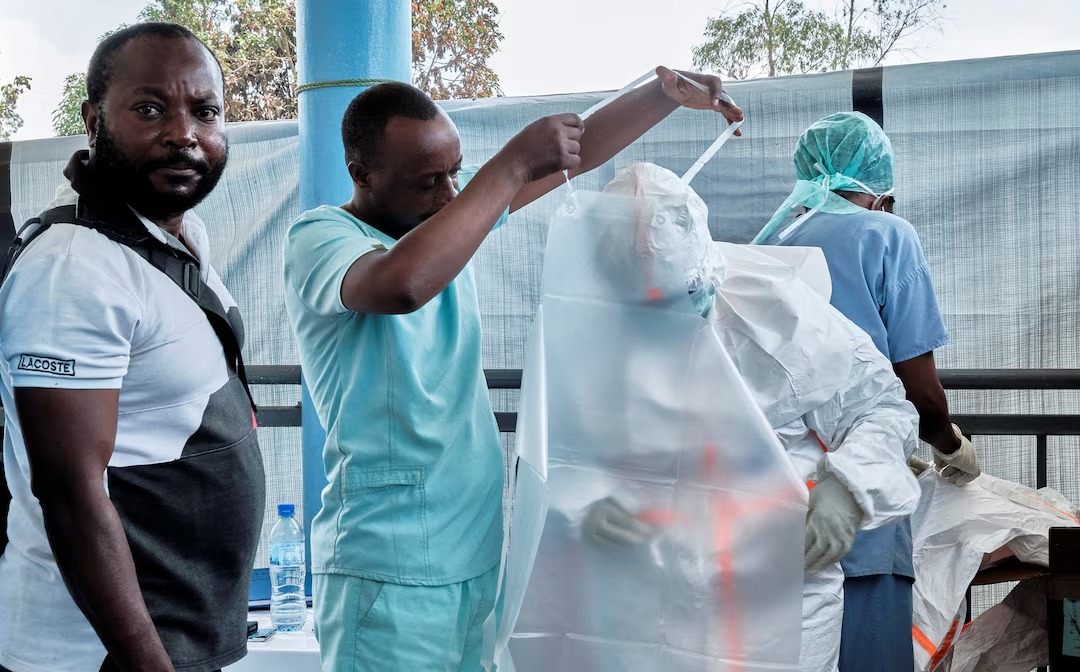
Treatment centres and response facilities have come under attack, disrupting medical operations and frightening patients away from care.
Recent incidents in Ituri province included arson attacks on Ebola treatment facilities, forcing patients to flee and undermining surveillance efforts.
Health officials warn that such disruptions increase the risk of infected individuals returning to their communities and spreading the disease further.
The attacks reflect a complex mixture of insecurity and mistrust.
Eastern Congo has long been affected by the presence of armed groups, including rebel militias operating across the region.
At the same time, some communities remain suspicious of outside authorities and international health workers.
Public health specialists note that misinformation, fear, and frustration over poor access to basic services can fuel hostility towards Ebola responders.
During previous outbreaks, community resistance significantly hindered containment efforts.
Speaking during an earlier Ebola response in the region, Tedros warned that attacks on treatment centres were “attacks on the community” and said armed groups risked reversing hard-won gains against the virus.
He stressed the need to balance security measures with efforts to build trust among local populations.
Other UN officials have echoed those concerns during recent visits to the outbreak zone.
WHO representatives have highlighted what they describe as significant uncertainty about the number of infections and the geographical extent of transmission.
Officials say delayed diagnosis, limited laboratory capacity, and difficulties identifying the original source of the outbreak have all complicated response efforts.
The growing outbreak has also triggered tensions elsewhere in East Africa.
In Kenya, hundreds of residents recently protested against plans to establish a United States-supported Ebola quarantine facility at the Laikipia Air Base in Nanyuki.
The proposed 50-bed centre is intended to house asymptomatic Americans who may have been exposed to the virus during deployments or humanitarian operations in affected areas.
Protesters expressed fears that hosting potentially exposed individuals could endanger local communities.
Demonstrators gathered near the base, demanding that the project be abandoned and questioning why such a facility should be located in Kenya rather than closer to the outbreak’s epicentre.
The protests followed a decision by Kenya’s High Court to temporarily suspend implementation of the plan while legal challenges are considered.
Kenyan authorities have defended the proposal as part of broader efforts to strengthen emergency preparedness.
Health Minister Aden Duale said the facility would support national and international response capabilities and would not be restricted exclusively to American citizens.
Nevertheless, concerns among residents have remained high, highlighting the fear that Ebola outbreaks continue to generate far beyond affected communities.
For international health agencies, the outbreak serves as a reminder of the difficulties of controlling deadly infectious diseases in regions affected by conflict and instability.
WHO has upgraded its assessment of the national risk level in the DRC and continues to deploy specialists, supplies, and emergency funding to the affected areas.
Global health organisations are also accelerating efforts to develop vaccines against the Bundibugyo strain.
Despite those efforts, officials warn that time is critical.
Unless security improves, community trust is strengthened, and surveillance expands significantly, the outbreak could continue to outpace containment measures.
For health workers on the front lines, the challenge is no longer simply fighting a virus but doing so amid conflict, fear, and growing regional anxiety.
Disclaimer: This article was compiled using the AI tool ChatGPT and may contain inaccuracies