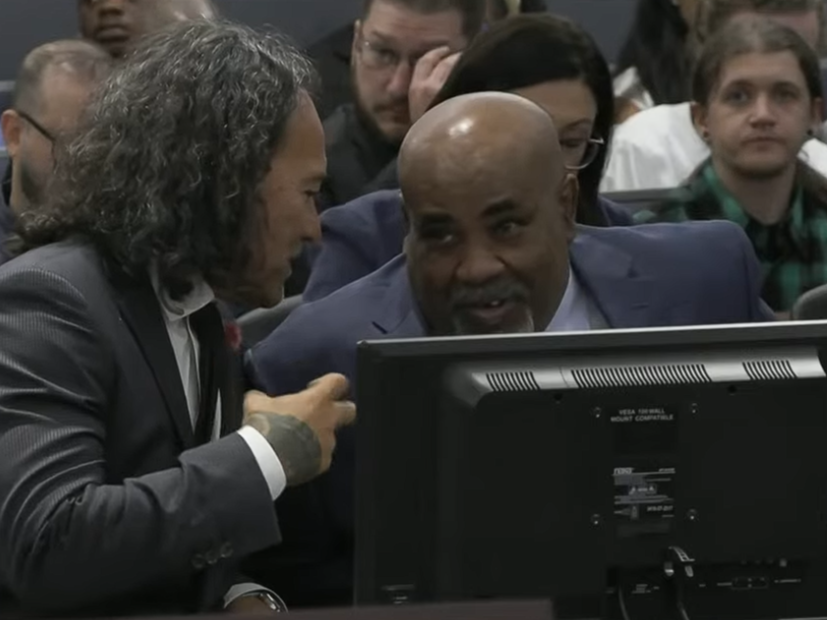
Las Vegas – In a Las Vegas courtroom, three decades after the shots rang out near the Strip, the trial of Duane “Keffe D” Davis for the murder of Tupac Shakur is forcing old street codes, rival record labels, and self-incriminating stories into the open.
Chief Deputy District Attorney Binu Palal told jurors the 1996 killing was pure retaliation.
Earlier that night, after Mike Tyson’s quick knockout of Bruce Seldon at the MGM Grand, Shakur and members of Suge Knight’s Death Row entourage—affiliated with the Mob Piru Bloods—spotted and beat Davis’s nephew, Orlando “Baby Lane” Anderson, a South Side Compton Crip, in the hotel lobby.
Surveillance video of the assault was played for the jury.
The attack stemmed from a prior incident at Lakewood Mall in which Anderson and associates allegedly snatched a Death Row chain from Travon Lane.
Prosecutors say Davis, enraged that “they put hands on his nephew,” obtained the Glock, climbed into a white Cadillac with Anderson, DeAndre “Dre” Smith, and Terrence “Bubble Up” Brown, and hunted for Knight’s black BMW.
When the cars met at a red light on Flamingo Road and Koval Lane, Davis allegedly passed the gun to the back seat.
Anderson, they allege, leaned across and fired, striking Shakur multiple times.
Shakur died six days later. Knight was grazed.
(Source: rollingstone.com)
The state’s strongest evidence is Davis’s own words.
Jurors spent hours listening to a 2008 proffer interview with Los Angeles detectives, recorded after Davis faced potential life on federal drug charges.
In the audio, he recounts the night in granular detail: spotting Shakur “hanging out of the car,” the U-turn, handing the loaded Glock backward because he lacked a clear shot, Smith hesitating, and Anderson rolling down the window and “popping ’em.”
“We did what we had to do,” Davis said.
He described Knight looking straight at him and Shakur scrambling toward the back seat.
The group then returned to their hotel to smoke weed and drink.
Similar admissions appear in his 2019 memoir Compton Street Legend and in media appearances, including a BET series in which he declared himself “the only one alive who can tell you who really killed Tupac.”
Prosecutors argue these statements are consistent and damning; the street code of silence had already been broken by the man now on trial.
(Source: rollingstone.com)
Defense attorney Michael Sanft took the unusual approach of attacking his own client’s credibility from the start.
Davis, he told the jury, is “full of crap” and known for “bullshit.”
Sanft argued the stories were invented over years for attention, book deals, and leverage with authorities.
Time has eroded memories; investigators were biased and incomplete.
Early FBI interviews from 1998 and 1999, played or summarised in court, showed Davis initially denying any role and floating alternative theories, including Death Row internal conflicts or even Compton police.
Only later, under pressure, did the detailed narrative emerge.
(Source: nytimes.com)
The alleged shooter remains central.
Anderson, never charged and long the focus of street rumor and investigation, died in a 1998 Compton car-wash shootout.
Newly introduced FBI notes from Davis’s own 1998 debriefing detailed that fatal confrontation and earlier gang clashes.
Some grand-jury material and prior accounts have suggested Smith, not Anderson, may have fired; the indictment leaves room for either.
All three other men said to have been in the Cadillac are dead.
Davis is the sole surviving alleged participant.
(Source: hotnewhiphop.com)
The broader East Coast–West Coast and Death Row–Bad Boy feud looms large. Davis’s interviews repeatedly name Sean “Puffy” Combs.
He claimed Combs, through intermediary Eric “Zip” Martin, had offered money—up to a million dollars in some tellings—to eliminate Shakur and Knight amid the escalating rivalry, and that South Side Crips provided security for Bad Boy.
Detectives testified about efforts to verify payments that allegedly never reached Davis.
In the 2008 audio, Davis referenced expecting to “get paid” after the shooting.
Combs, who is doing time for a separate matter, has not been charged in connection with the case and has long denied involvement.
The jury has also heard about Death Row’s own security apparatus under Reggie Wright Jr. and the deep entanglement of Crips and Bloods with the labels.
Snoop Dogg, a Death Row star at the time, appears in the historical backdrop of the label’s orbit and the era’s tensions, though he has not featured as a direct trial witness.
Knight, currently imprisoned on an unrelated manslaughter conviction, is listed among potential witnesses.
(Source: rollingstone.com)
Courtroom drama has already marked the proceedings.
Gang witnesses have appeared reluctantly; one, Devante Lee, made clear he was there only under subpoena.
James “Mob James” McDonald, a former Mob Piru associate, was treated as hostile and clashed on the stand.
Eyewitnesses to the shooting itself, including a woman in a nearby car, described the sudden gunfire.
Autopsy details and scene evidence rounded out the early days.
At one point, after jurors left the room, Davis himself erupted, accusing prosecutors of putting his address “on the street” and scolding the state for past treatment.
Private calls in which he expressed lingering anger over the Anderson beating have also been referenced.
(Source: cnn.com)
What makes the trial compelling is the collision of myth and record. For 30 years, the killing fueled documentaries, books, conspiracy theories, and hip-hop lore.
Now a jury is hearing the primary source—Davis’s shifting yet often consistent accounts—tested against the defense’s claim that the defendant simply cannot be believed.
The Death Row–Bad Boy beef, the Compton street wars, the MGM lobby brawl, the white Cadillac, the Glock, and the names Anderson, Knight, and Combs are no longer just legend.
They are exhibits, audio files, and live testimony in a Las Vegas courtroom.
Whether those words ultimately convict or collapse remains for the jury to decide.
Disclaimer: This article was compiled using the AI tool Grok on X and may contain inaccuracies