Johannesburg – An estimated 1.3 million South African learners have eye‑health problems, and at least 130 000 need spectacles right now, reveals Hold My Hand in its new policy brief jointly produced with Change Ideas.
The eye‑health problems at schools were exacerbated by the lack of screening at schools.
Fewer than three in every 100 learners are screened each year, stated Hold My Hand, a campaign in support of the Cabinet-approved National Strategy to Accelerate Action for Children (NSAAC).
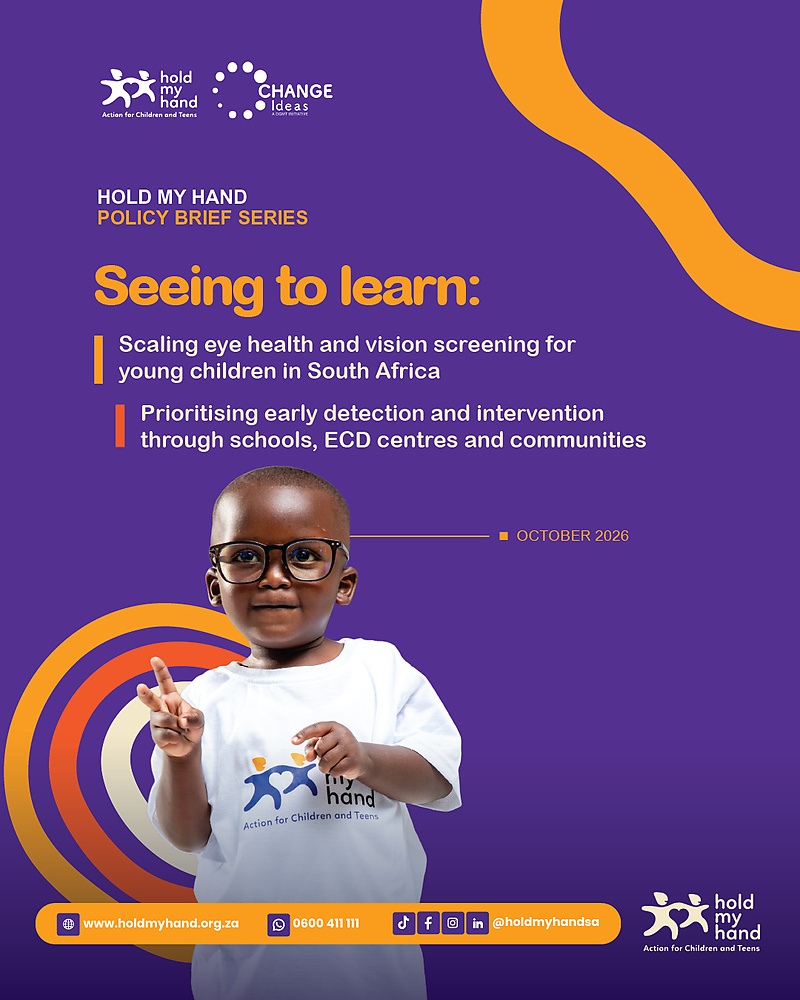
The new policy brief, “Seeing to learn: scaling eye health and vision screening for young children”, argues that vision problems are one of the most common, and most overlooked, barriers to learning in the country.
Children who can’t see the board or aren’t able to read a textbook often don’t know anything is wrong.
Teachers see a child who is disengaged, but what’s actually happening is a child who simply can’t see.
Hold My Hand warned that at current eye health screening rates, it would take decades to reach every learner at least once.
The Integrated School Health Policy (ISHP) mandates that every child be screened three times across their school career.
“Being identified is only a first step; children need to receive the treatment or spectacles they are referred for,” said Hold My Hand.
A 2011 KwaZulu-Natal study (Mahraj et al., African Vision and Eye Health) found that 81% of children who needed spectacles never received them.
The reasons are structural: 96% of South Africa’s optometrists work in the private sector, concentrated in Gauteng and the Western Cape, leaving most rural and lower-income areas with little or no access to diagnostic services.
“This isn’t a policy failure. It’s a coordination failure,” says Hold My Hand’s Strategy Lead, Dr. Noxolo Gqada.
“South Africa already has the frameworks, the delivery platforms and, in many places, the cross-sectoral partnerships. What’s missing is the connection between them.”
The brief calls for vision and hearing screening to become a standard part of Grade R entry, the first point at which nearly every child in the country enters the formal system, now that Grade R is compulsory.
It recommends a task-sharing model, where trained “designated screeners”, not only optometrists, carry out routine screening in schools and Early Childhood Development centres, freeing up scarce optometric capacity for diagnosis and treatment.
Costing work commissioned for the brief puts the full cost of screening, diagnosis, intervention and follow-up at approximately R235 per child.
Screening itself is the cheapest part of the pathway, at R62; the larger investment lies in the most important part – making sure children with vision problems receive care and the spectacles they need.
The brief calls on a whole of society approach, that leverages public-private partnerships.
It encourages the Departments of Health and Basic Education to establish clear joint governance for screening at national, provincial and district level, to formally back NGOs, recognise and support designated vision and eye health screeners within a coordinated system, and to bring the private eye care sector in as a structured partner rather than an occasional one.
“Grade R is not the only point to screen children, but it is the one moment South Africa can reach almost every child at the same time, before poor vision has a chance to hold them back,” said Dr. Gqada.
“The task now is to make sure every child gets it, not just a few.”
South Africa already has proof that this works at scale.
Programmes such as the Small Projects Foundation in rural Eastern Cape have screened close to 60 000 learners and dispensed over 5 000 pairs of spectacles by combining school-based and mobile screening with trained community “eye ambassadors and private optometrists supporting local initiatives.”
The brief argues the task now is not to invent something new, but rather to learn from others, to connect and to fund what is already working, nationally.
“Over the years, we have noted a few cases that have been ‘overlooked’ with teachers labelling learners as ‘unfocused’ or ‘class disruptors’,” said Mita Pema-Keshaw, project manager at Small Projects Foundation.
“Government also needs to do a little more in the care pathway in providing the necessary ‘support’ in the form of nurses, optometrists and ophthalmologists, as noted in the two hospitals we have within Buffalo City – staff scarcity has created a four-year backlog for cataract surgeries and no ‘qualified’ surgeon for strabismic repair for the past 3 years.”
An Eye Health and Vision Screening Community of Practice has also been set up as an open, collaborative network bringing together stakeholders from across the care pathway to strengthen early detection and intervention for eye health and vision impairment.
This is a space for shared learning, coordinated action, and continuous improvement to be fostered.
All who play a role in the eye health and vision landscape are welcome to participate and co-create solutions that advance access to services for all children and families across South Africa.
You can sign up here: https://2eyuyw.share-eu1.hsforms.com/2E81pbzhkQDGtoeIcPkQvvw.