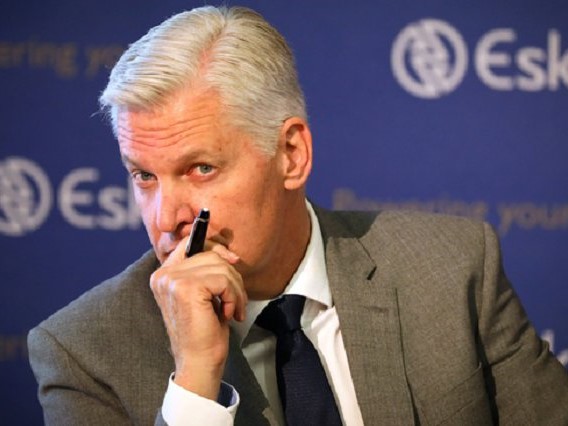
Johannesburg – Business Leadership South Africa (BLSA) on Thursday said it was with “great disappointment” that it learnt of André de Ruyters resignation as CEO of Eskom.
The CEO of the struggling power utility threw in the towel on Wednesday, but with remain at the helm until 31 March 2023.
RELATED: Eskom CEO André De Ruyter Quits, NUMSA Chuffed, Others Worried – The Bulrushes
BLSA said De Ruyter was “operating under extremely difficult conditions”, which included crippling debt, political opposition, and insufficient generation capacity having been procured in time to avert the current state of extreme load shedding.
There were also problems related to missed “historical maintenance” of the power utilitys plant and equipment resulting in frequent breakdowns..
BLSA agrees with BUSA CEO Cas Cavoodia that certain utterances by some in government and other sectors have been irresponsible.
“We believe De Ruyter has taken Eskom in the right direction,” BLSA said.
“Internally he has done much to rebuild the skills base and strengthen discipline and operational processes which were destroyed in the years of state capture prior to his appointment.
“Loadshedding, however, got progressively worse during his tenure with CSIR figures showing Eskom had shed 5,761GWh in the first nine months of this year, more than double last years 2,521GWh.
“This was used as a stick to beat him with despite him having predicted that load-shedding would be part of our daily lives until end-2022 at the time of his appointment.”
De Ruyter cited numerous factors chief of which was the high levels of downtime required for maintenance due to the aging power plants and historical neglect.
Four of SAs major plants, namely: Komati, Camden, Grootvlei, and Hendrina, are all over 50 years old.
Increasing incidents of sabotage have directly caused higher stages of load-shedding.
“The primary reason for the excessive load-shedding, however, is the lack of new generation capacity coming on stream, which is a direct failure of the government, particularly in relation to the breakdown in the Renewable Energy Independent Power Producers Procurement Programme,” BLSA said.
Bid Window 4, held in 2015, was delayed for four years because of state corruption, while the subsequent bid windows were floundering.
BLSA said the government was showing “no ability or indeed willpower” to get the programme back on track.
Consequently, there is simply not enough capacity to keep the lights on.
“Had new renewable energy been procured every year since 2015 as scheduled, we would not be suffering such extreme load-shedding today,” said BLSA.
“De Ruyter also kickstarted SAs just energy transition through focused advocacy, culminating in the repurposing of the Komati power station into a renewable generation site.”
Funded by the World Bank, the project has a strong focus on job retention, reskilling, and creating new jobs.
“He also initiated the leasing of Eskom land to private sector operators to develop renewable energy plants,” said BLSA.
“His actions have been widely applauded internationally for developing a prototype model for countries to transition from coal with minimal job losses and strong community upliftment components.”
BLSA said it was extremely concerned that international support for SAs just energy transition might now be at risk if a change in CEO at Eskom signals a change in approach.
Another concern, BLSA said, was the high churn of CEOs at all state-owned enterprises, which has hampered progress and disrupted policy continuation.
Since 2007, Eskom has had 13 CEOs including interim appointments.
“We hope the new CEO receives the necessary political and public support to see through the important initiatives De Ruyter has started while being set realistic targets,” said BLSA.
The lack of funding for diesel supplies was a severe handicap in the fight to ease the load-shedding crisis, as is the urgent need to increase transmission capacity.
BLSA said addressing the destructive acts of sabotage at power plants should be a “top priority for our law enforcement”.
In a statement, BLSA “thanks De Ruyter for the hard work and full commitment he brought to the role and wishes him the best in the future”.
BLSA said it was “also committed to continuing to support Eskom and government in their efforts to stabilise the countrys energy supply as quickly as possible through the Presidents energy crisis plan announced in July”.